Sharpless 157 is a sprawling HII emission nebula sitting on the Cassiopeia/Cepheus border. It is approximately 8,000 to 11,000 light years away and spans about 1 arc degree of the sky.
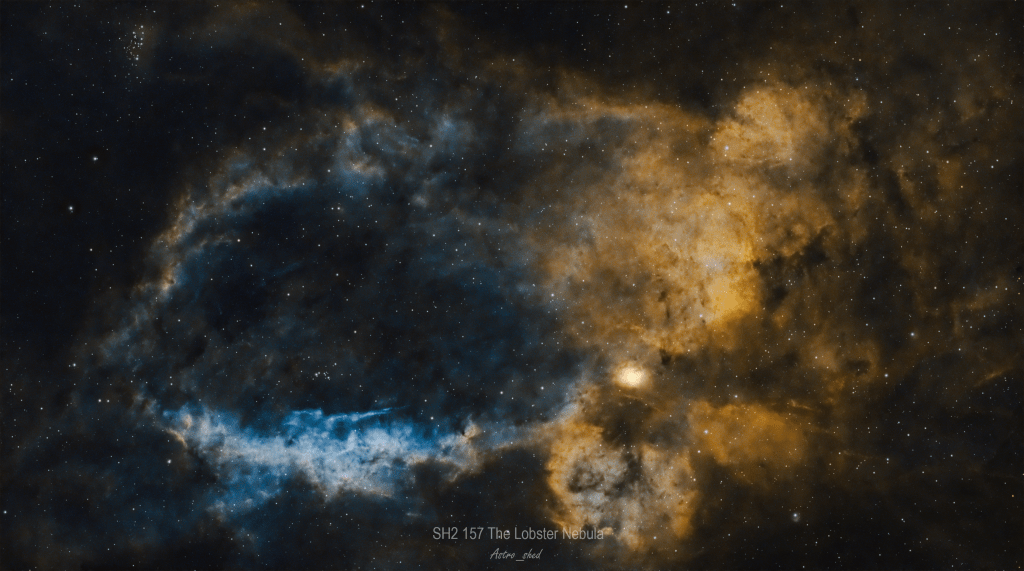
It consists of two different parts. The blue “claw” part on the Northern (left) side is a ring nebula surrounding Wolf Rayet Star WR 157. This WR star sits in the young open star cluster, Markarian 50 that is visible just above the bright blue arc on the bottom of the “claw.”
The Southern (right) side of the nebula is an HII region that is energized by young hot stellar sources. The bright knot of color at the base of the claw is another HII emission area and is commonly referred to as SH2-157B. HII regions are areas of ionized hydrogen gas and typically are associated with active star forming regions.
Also in the image at the top left is the small open cluster NGC 7510. It is approximately 11,000 light years away and is about 10 million years old. It is classified as a Trumpler Classification of II-2-m, which is a detached cluster with little concentration of 50 to 100 stars of medium brightness range.
Visually, this is a difficult object unless an OIII filter is used. Photographically, this is a great narrow band target. I captured this image using my AT80ED scope and the QHYCCD miniCam8 camera. The image is a combination of 2 hours each of Sii, Ha and Oiii subs. The Sii, Ha and Oii images were mapped to the Red, Blue and Green channels to create this high contrast image. My only regret is that I did not capture RGB for the stars.

 Astro-Shed
Leave a comment