This week’s capture is Messier 94 (NGC 4736) also known as the Cat’s Eye Galaxy. It was discovered by Pierre Mechain in 1781 and entered into Messier’s catalogue two days later. It lies 16M Ly’s away in Canes Venatici and is part of our Local Group of Galaxies.
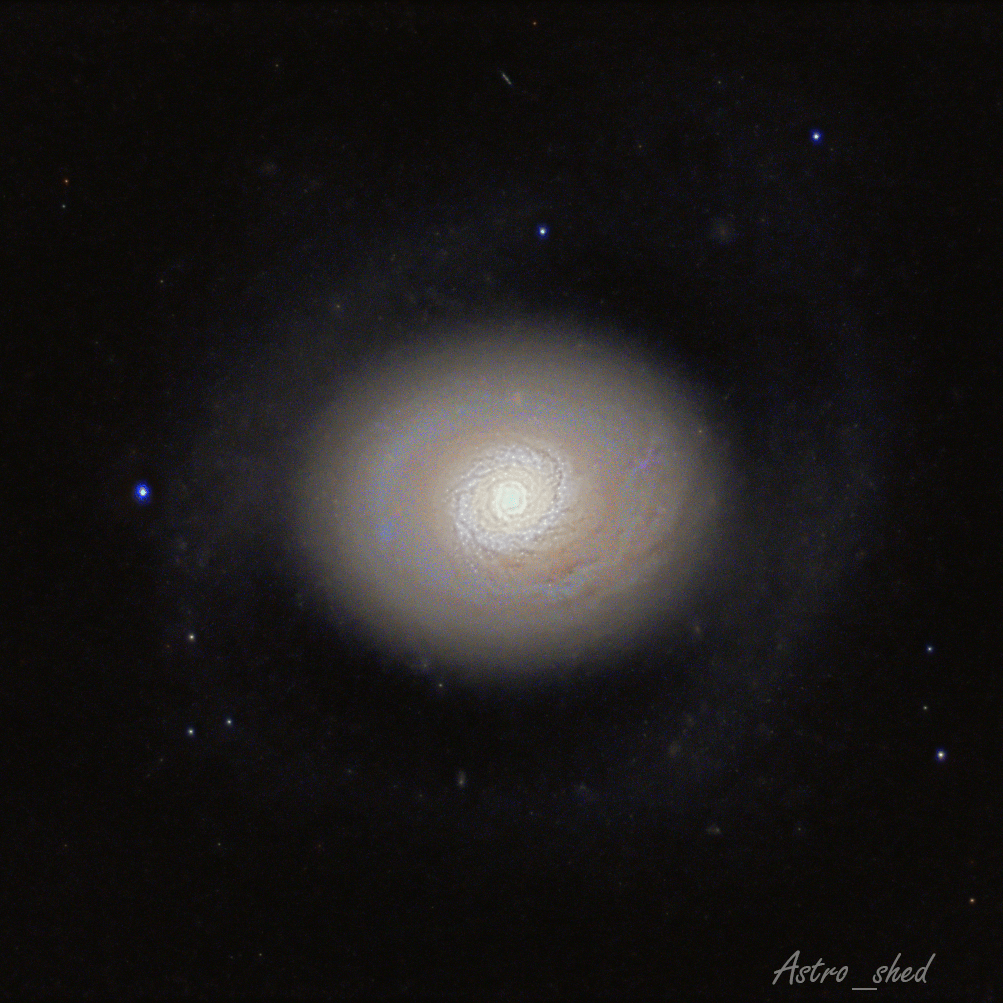
M 94 is a face on spiral. The arms of the spiral are tightly wound around its nucleus. There is a strong star forming region forming an inner ring that shines in blues and reds.
The Messier Catalogue has other examples of Ringed Spiral galaxies, two of which are Messier 95 and Messier 109, both of which I captured easlier this year.
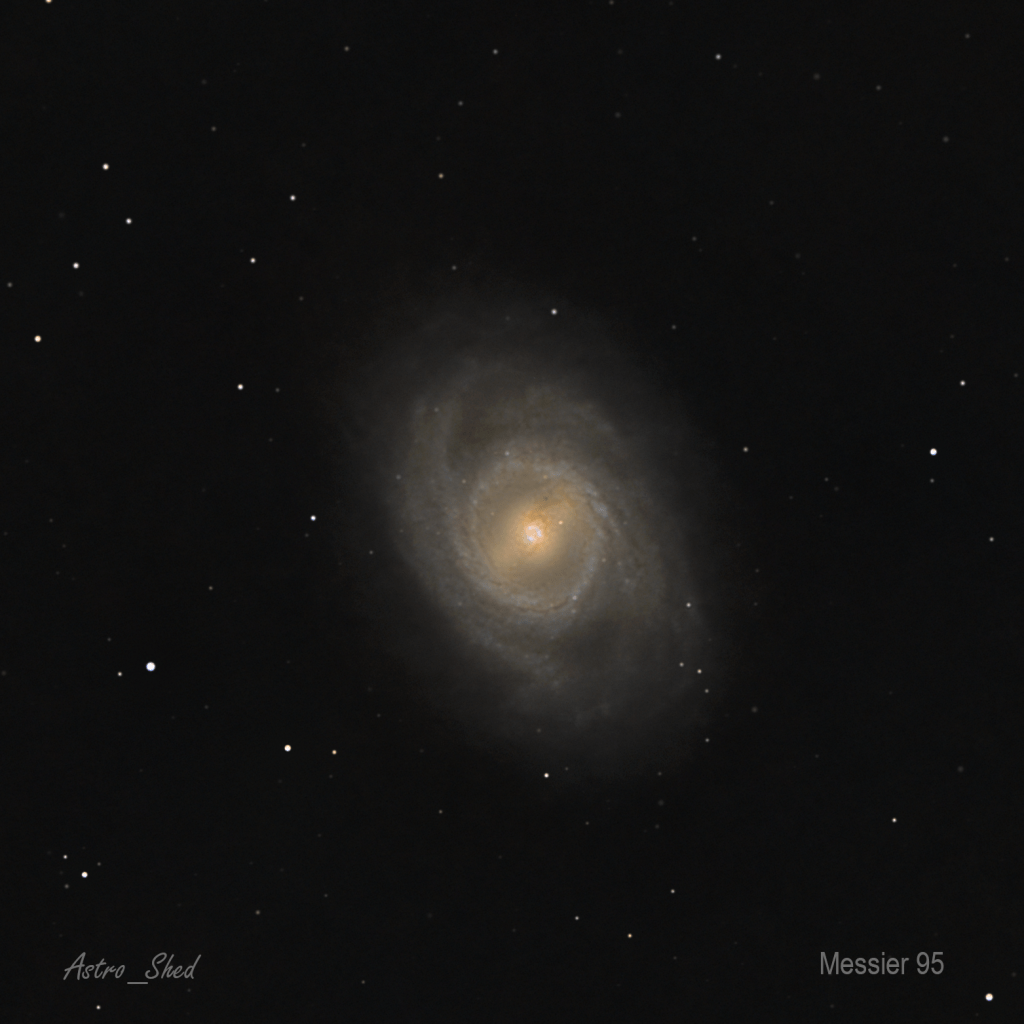
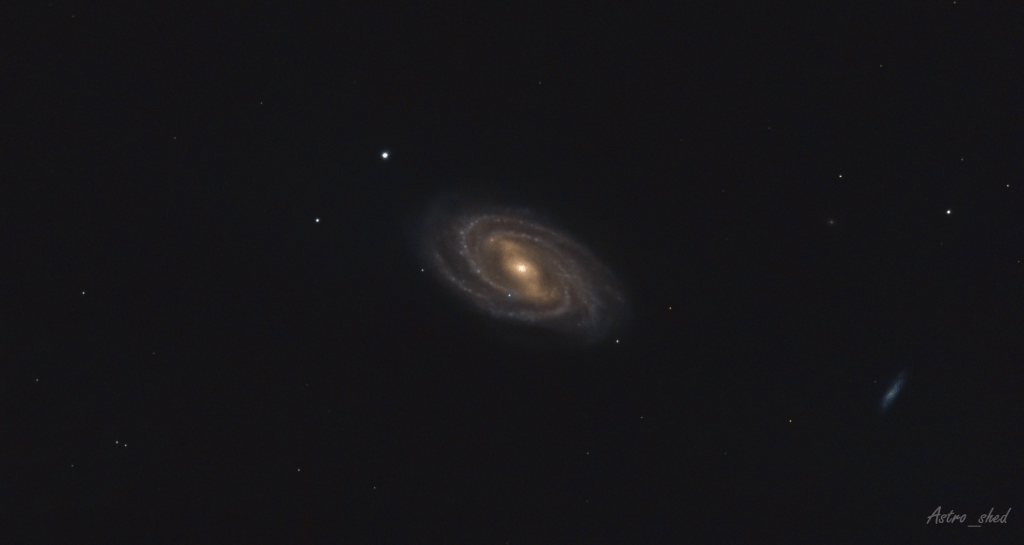
Studies have determined that these ring structures are formed by resonances set up in the gravitational field of galaxies by their bar structure.
M94 is somewhat unique as it not only contains a strong inner ring but also contains a weaker outer ring, creating a void of stars between the outer and inner rings. You don’t see this in the other two Ringed Spirals here which have much stronger bars than M94.
This galaxy was actually a difficult image to capture and process as the outer ring signal is not that far above the background sky signal. I would normally use an extended sub exposure time to capture this faint structure, however, the inner ring is really bright and I found the loner subs were blowing out all the central details. I ended up going un-binned with 60 sec subs. I integrated 9 hours of LRGB data from my 8″ Celestron SCT and QHYCCD miniCam 8 scope and camera.
I stretched the RGB and Luminance images separately before adding the Luminance to make the final LRGB image. The un-binned image at the SCT’s 1279mm focal length ends up to be a softer presentation as compared to the other two images which were binned at 2X.
clear skies.
 Astro-Shed
Leave a comment