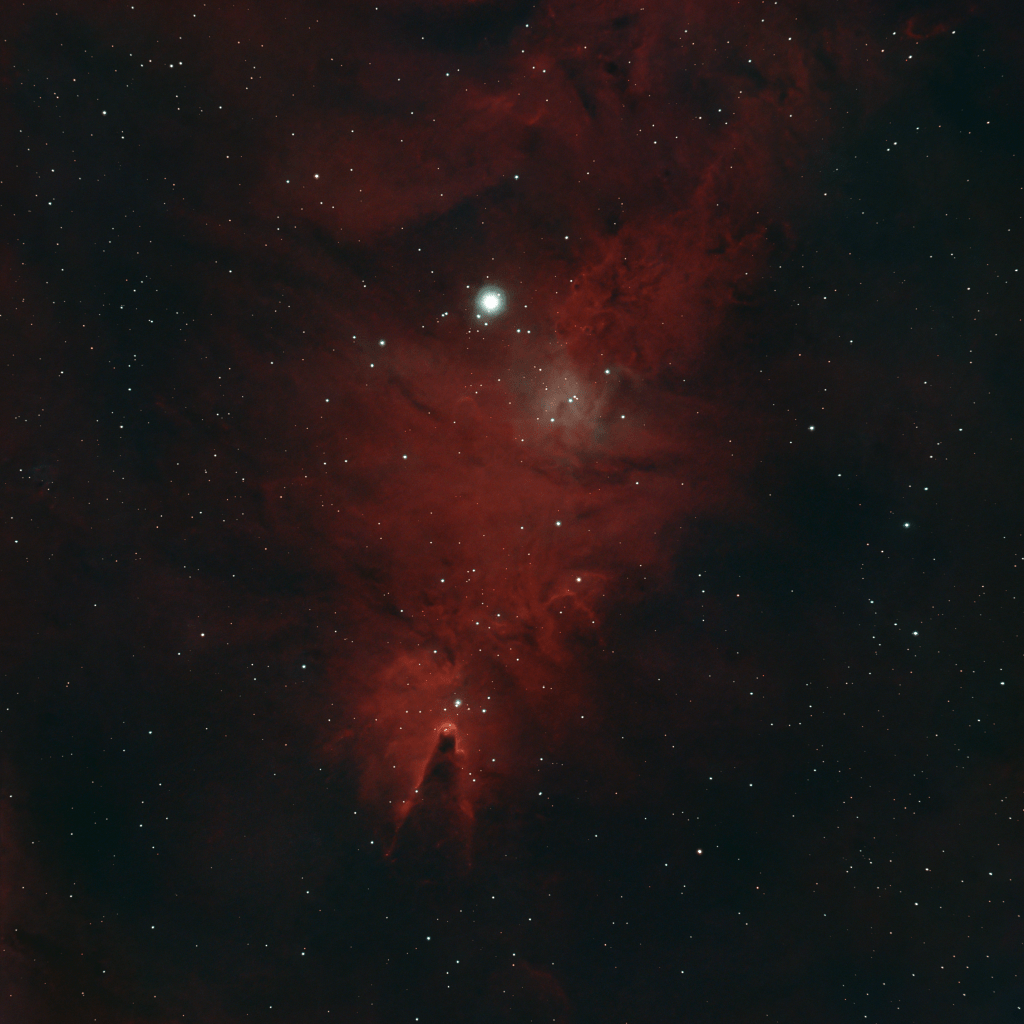
Nights with a bright moon can be a challenge for imaging. You either need to choose a bright object that is located away from the moon, or image in narrow band which typically means imaging an emission nebula like the example above. This is the Cone Nebula and Christmas Tree Star Cluster, NGC 2264. The narrow band filter reduces the light from the moon and only allows wavelengths specific to hydrogen-alpha and oxygen-III to pass.
The cluster and nebulae are located in the constellation of Monoceros and are about 2600 lightyears from us. The bright star is S Monoceros and is the “star” on the top of the tree. To be honest I have trouble seeing the tree, but I think it is the lighter OIIII signal in the image.
S Monoceros is part of a cluster of stars, many of which are younger, hotter and larger than our own Sun. They provide the energy to ionize the gas in this region. The hydrogen gas is fueling the star birth in the cluster. Gravity causes the gas to collapse and as its density increases, it gets hotter. Eventually the conditions are right to initiate nuclear fusion and a star is born, a process that takes many millions of years.
The Cone nebula is interesting, as it is actually an absorption nebula consisting of cold, dense gas which is between us and the ionized gas of the emission nebula. This results in blocking the light from the emission nebula and creating the distinct cone shape that appears to be pushing into the nebula.
Imaged on 1-11-25
AstroTech AT80 scope
ZWO ASI533MC Pro camera
ZWO Duo-band filter
ZWO AM5n mount
60×180 sec subs, 3 hours total integration
 Astro-Shed
Leave a comment