Sh2-248 is the Jellyfish Nebula, a supernova remnant in Gemini. Visually it’s a lacy web of shock-heated filaments: strong Hα arcs and lots of O III structure that can give it that teal/blue “glow” in narrowband. It sits near the bright star η Geminorum (Propus), and spans roughly ~45–50 arcminutes (bigger than the full Moon). It’s about ~5,000 light-years away and is a well-studied example of an SNR interacting with surrounding molecular clouds.
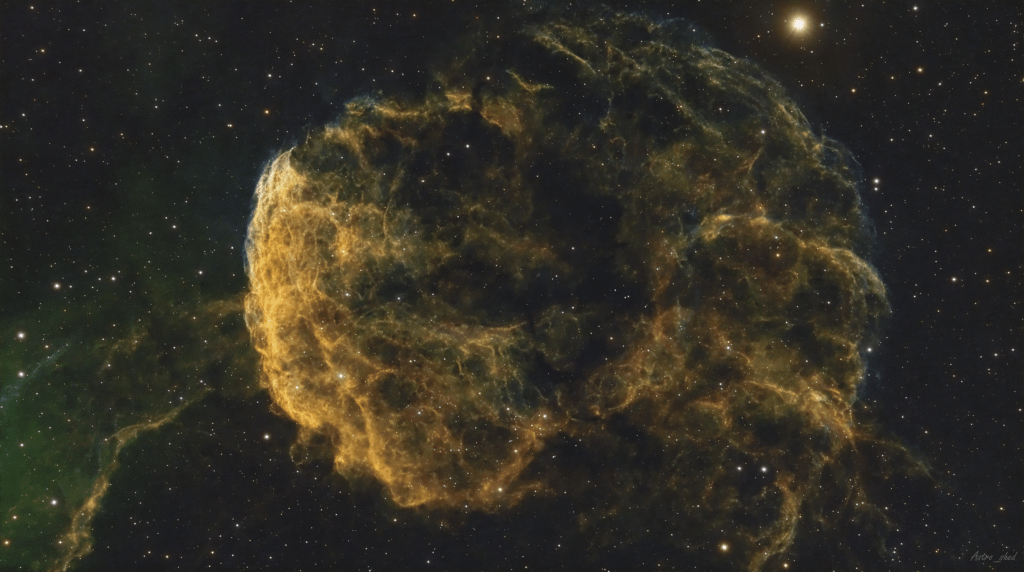
I found that the OIII structures of the object as framed above were quite faint and limited in scope. This resulted in imaging the object of 3 nights and collecting a total of 17 hours of data in SII, Ha, OIII, and RGB.
The pallet chosen for the object began as a standard SHO pallet where SII is mapped to red, Ha to Green and OIII to blue. This resulted in a rather unsatisfactory result as the image was rather flat and overly gold/brown in color. The delicate filaments seem to get lost in the image as well as having artifacts from the sharpening that was used.
Use of AI
As an experiment, I asked ChatGPT to critique my image. This was the first time I used AI to suggest improvements to my imaging processing and I was blown away with its analysis and suggestions. It came back with the strengths and the areas that needed improvement, along with suggestions to modify the processing techniques.
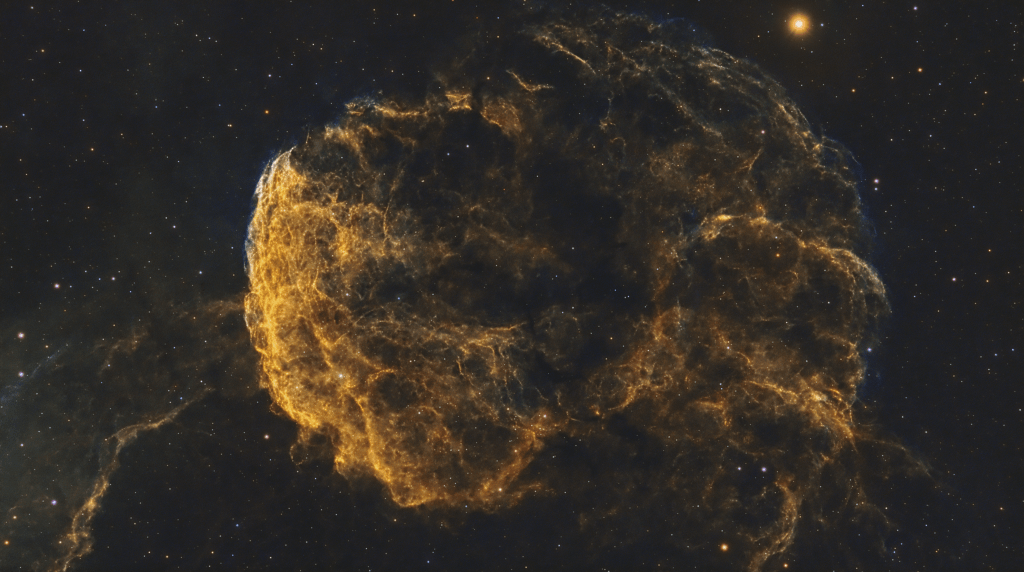
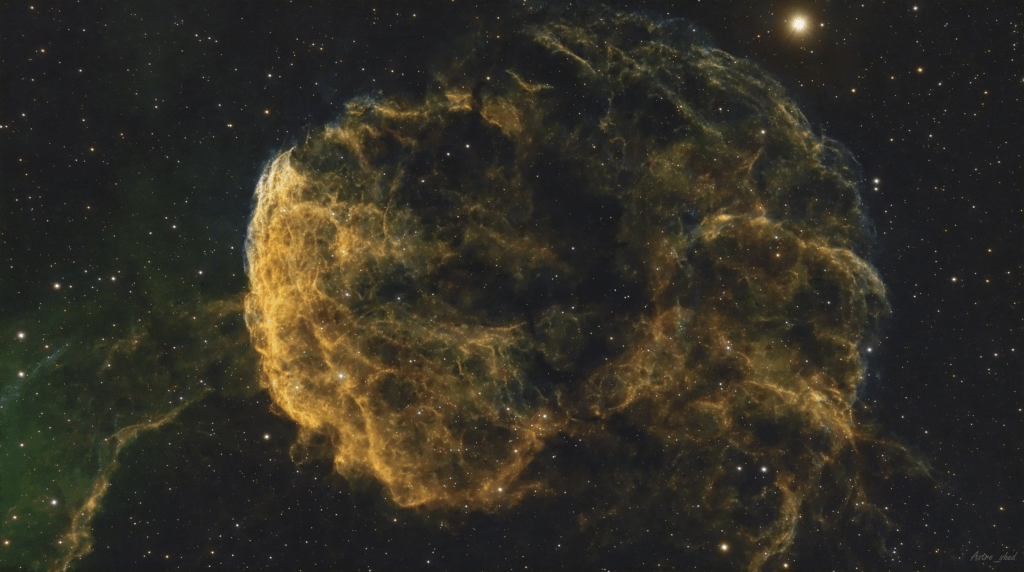
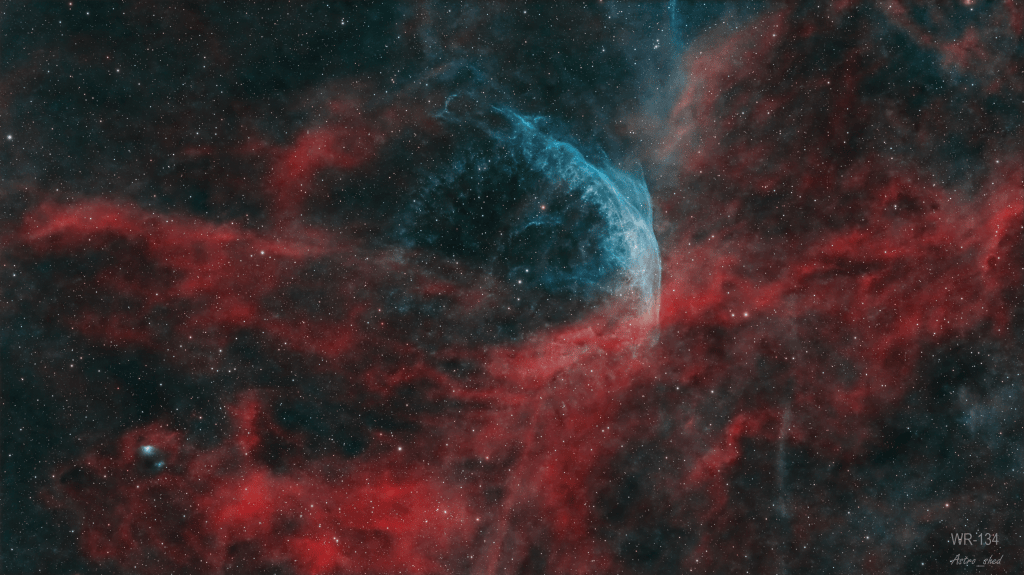
The images below are the before and after the AI processing suggestions. AI did not produce the final image, it only give me suggestions on how to change my processing of the raw image.
Processing
The final image blended the Ha into the Red channel, the OIII into the Green channel and boosted the OIII in the Blue channel. The blending was done through Pixel Math with ratios suggested by ChatGPT. It became an iterative process as I uploaded each revision and got further refinements on the blend ratios.
I resisted the urge to apply SCNR to reduce the Green in the final image as the Green helps to give the image depth and separates the Ha filaments from the SII dominated filaments. SCNR can result in greyish color of the fainter Ha regions.
The OIII in the blue channel is more visible, although the affect is subtle. The area I notice this the most is in the interior of the nebula where some OIII/blue is coming through adjacent to the large red filament. In hindsight, and upon more discussion with ChatGPT, I think I would increase the sub-exposure times for the OIII as it is barely above the background levels in this image.
The final steps were to add in the RGB stars, sharpen and de-noise the image. I found that sharpening the non-stellar structures followed by de-noising and then sharpening the stars resulted in fewer artifacts in the final final image.
Conclusion
Using the AI feedback was a rewarding experience. The AI not only gave me direction, but it provided the reasoning behind each suggestion. It helped to focus my attention on specific parts of the image. The AI will not in itself result in a more pleasing object, but it will help to process the image to create a physically more accurate image. I am pleased with the process here and plan to utilize AI feedback as part of my normal workflow in the process.
Imaging Equipment
- SVBony SV550 80mm scope,
- ZWO AM5n mount,
- QHYCCD miniCam8 camera.
Capture Details
- 114x180sec subs in each SII, Ha and OIII,
- 32x5sec subs in each RGB


Leave a Reply