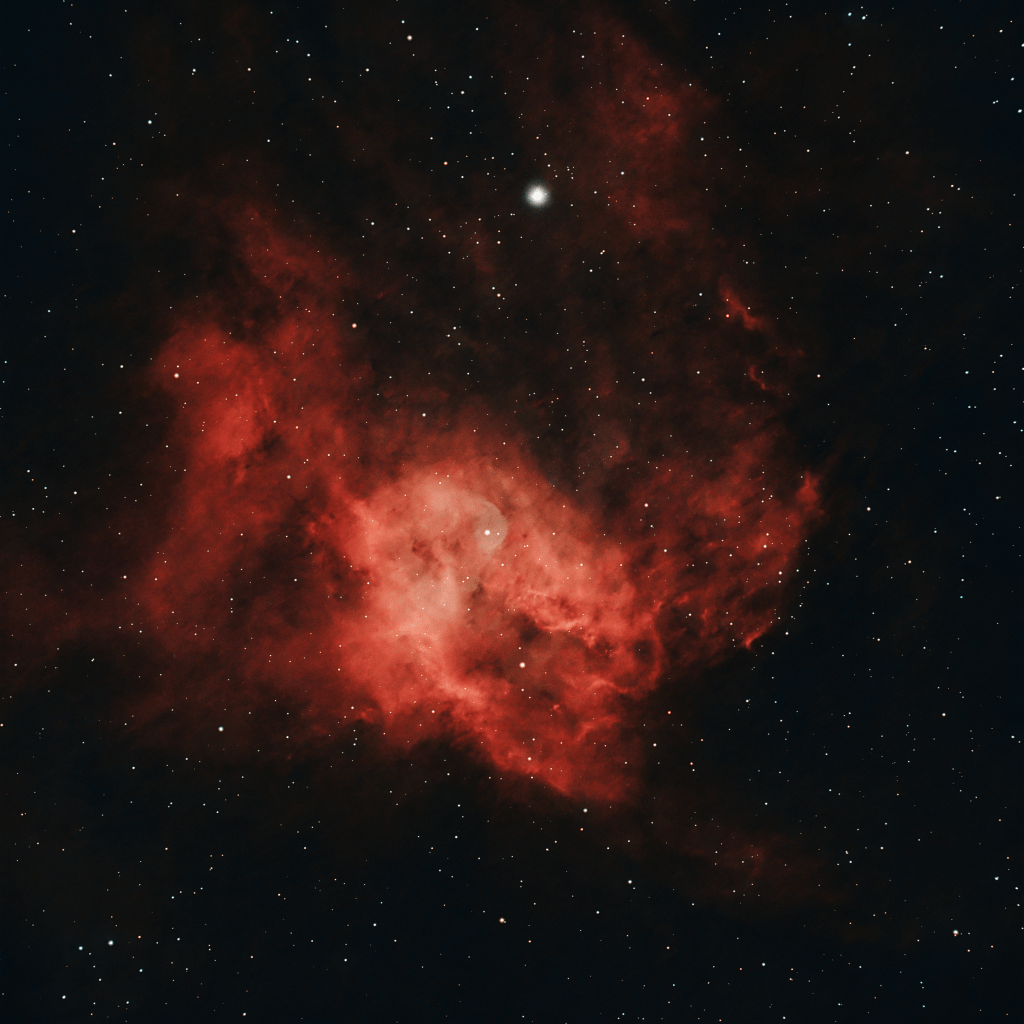
Sharpless 2-280 is a faint emission nebula in the constellation Monoceros. It is located approximately 2 degrees away from the more famous Rosette Nebula, which was the subject of my previous post. Being much fainter, this intriguing nebula, along with its proximity to its larger and brighter counterpart, is often overlooked by many astrophotographers who are eager to capture the vivid colors and shapes of the more popular celestial wonders.
The HII signal, associated with the glow of ionized hydrogen gas, is indeed much more prominent than the OIII signal, which only starts to reveal itself after about three hours of integration time. For me, the key feature of this nebula is the captivating OIII bubble located in the center, elegantly surrounding the bright central star. This bubble appears to form a possible bow shock wave, as the right side displays a much more dominant intensity compared to the left side, highlighting the dynamic processes at play in this mesmerizing region of space. The subtle interplay of light and gases within Sharpless 2-280 invites observers to contemplate the vastness of the universe and the hidden beauty within even the faintest of objects.
I ended up integrating about 4-1/2 hours of narrow band data to capture this image. The post processing was done with an eye to enhance the OIII signal. I’ve no doubt that more integration time would only enhance the image more.
This nebula does not have a common name however, my overall impression of the nebula is one of an in-flight owl swooping down on its prey with its wings stretched upwards behind it. Hence, I suggest it be known as “The Cosmic Owl.” Let me know in the comments if you see the “owl” or perhaps something else?
Astrotech AT80ED scope
ZWO ASI533MC Pro camera
ZWO Duo-narrow band filter
90×180 sec sub exposure.
 Astro-Shed
Leave a comment