Emission nebulae populate the spiral arms of our galaxy. Scientifically, they offer us a window into stellar formation. Aesthetically, they make wonderful targets for the astrophotographer.
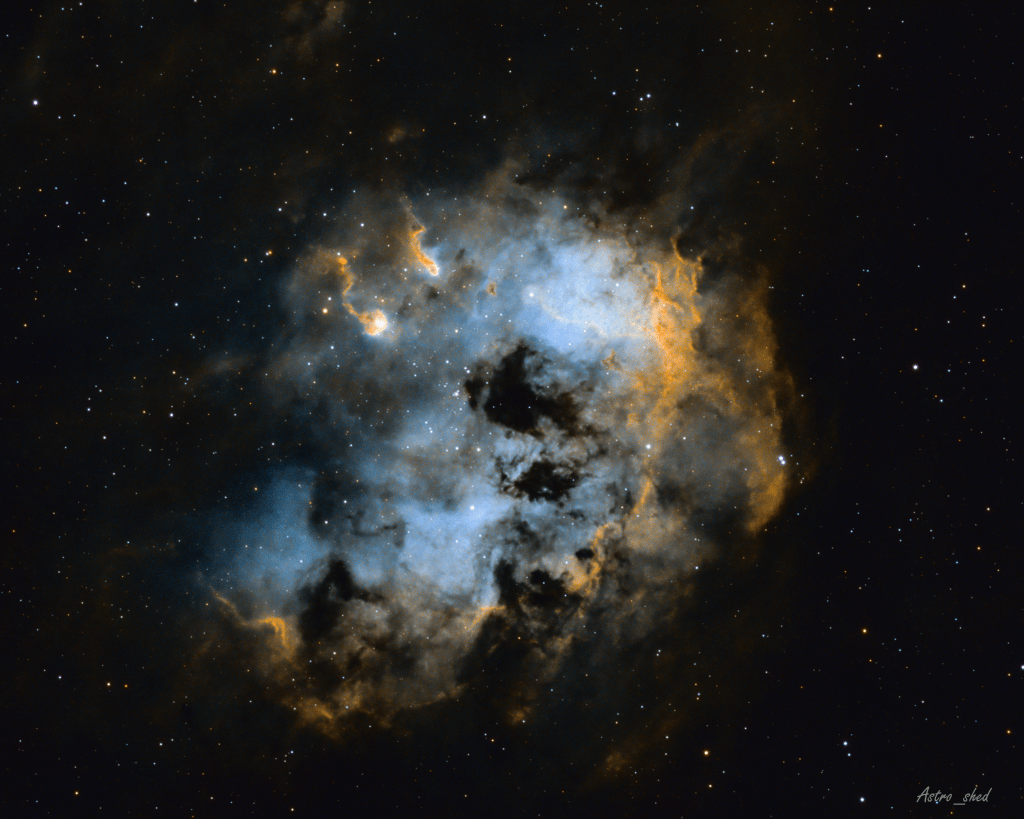
IC 410 is an example of one of these beautiful nebulae. IC 410 is an expansive cloud of ionized hydrogen known as an HII region. The cloud glows due to intense ultraviolet radiation from nearby young stars. The gas and dust are being sculpted into pillars, cavities, and filaments by stellar winds and radiation pressure.
A cluster of O and B-type stars provides the energy to ionize the gas in this nebula. NGC 1893 is the designation for this cluster which is located at the center of the nebula. The stellar winds from these massive, hot young stars have hollowed out the core of the nebula. These winds also formed the orange colored shock fronts in the image above.
The nebula and cluster have a diameter of about 70 million light years. They are at a distance of about 16,000 light years. This is one of the youngest known clusters in our galaxy. It is estimated to be less than 3 million years old. As such, it is an important laboratory for us to understand stellar formation.
Also in the image are two pillar-like objects which give the nebula its name, “The Tadpoles.” These are protostars wrapped in dust and gas. The stellar winds from the cluster have blown away most of this dust and gas. The gravity from the protostars clings onto some of the gas. This creates these beautiful pillars that point away from the cluster’s hottest stars. The pillars are about 10 light years long.
These pillars are thought to be sites of on-going stellar formation. You can see areas in the image where the gas seems to clump. These clumps create localized accretion areas. This process ultimately forms new stars.
The image was captured by a QHYCCD miniCam8 camera on an 80 mm SV550 triplet refractor and ZWO AM5n mount.
The image was created using SII, Ha and OIII filters and mapped to the Red, Green and Blue channels respectively. Total integration time was approximately 8 hours.
clear skies.


Leave a Reply