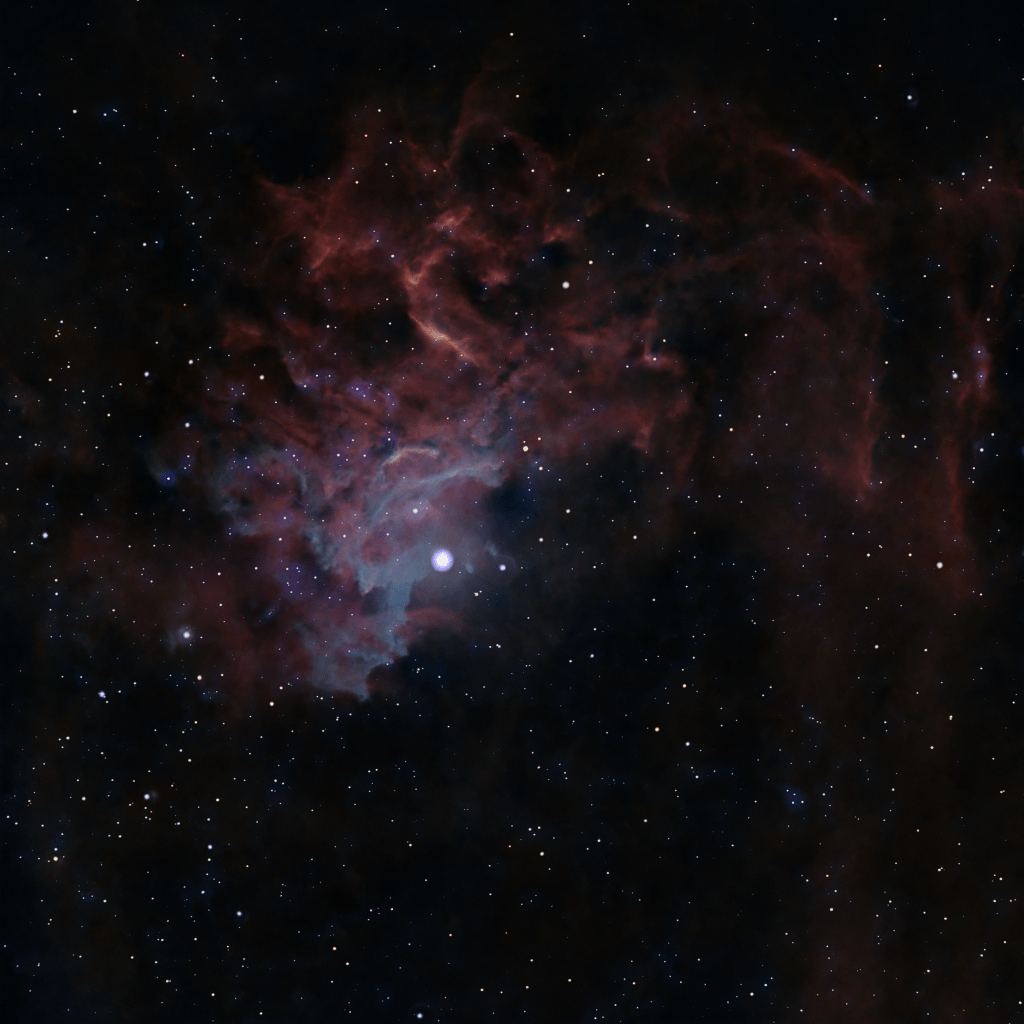
This week’s image is that of IC 405, otherwise known as the Flaming Star Nebula. It resides approximately 1,500 light years away in the constellation of Auriga.
The nebula consists of both an emission and reflection nebula. The bright star in the center is AE Auriga and is a hot blue star. The energy from this star excites the surrounding hydrogen gas and causes it to emit red wavelength light. This light, along with the blueish light from the star is reflected by surrounding dust to give the blueish purple light from the reflection nebula.
Imaging a reflection nebula with a OSC (one-shot-color) camera is best done in my opinion without a narrowband filter and hence I chose to use a UV/IR filter. However, one of the drawbacks here is that small blue halos appear around the brighter stars like the central star. The blue halos are an artifact of the doublet apochromatic refractor. A triplet would better correct the chromatic aberration and greatly reduce these halos.
A narrow band filter would emphasize the emission nebula more. There are lots of online images which show off the rich redness but lack the blueness of the reflection nebula. A monochrome camera would allow one a lot more flexibility and enable the imager ability to blend the RGB data with the narrowband data. One day I may be so lucky to own a mono camera and a triplet and have the best of both worlds.
AstroTech ED80 scope
ZWO ASI533MC Pro Camera
UV/IR Filter
4.75 hours integration of 3-minute sub exposures.
 Astro-Shed
Leave a comment