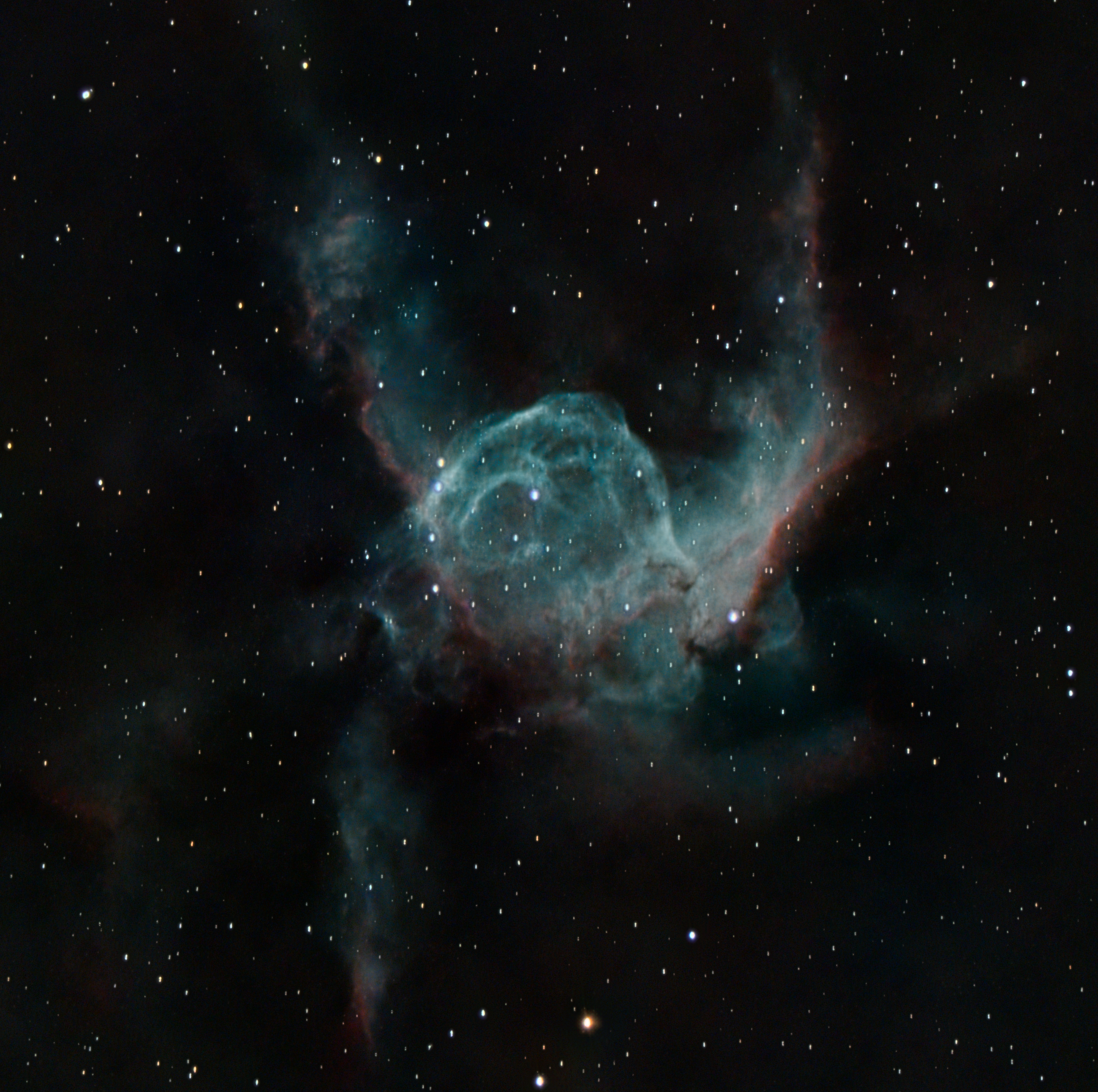
This week’s capture is that of NGC 2359, Thor’s Helmet. This is a beautiful nebula in Canis Major. It comprises a central illuminated bubble-like structure attached to two prominent “wings” giving rise to its name. There is however much more to this superhero’s headgear when we start to peel back its layers.
At the heart of the central bubble is a super-massive star called WR7. It has a mass of over 13,000 times that of our own sun resulting in a luminosity (brightness) of nearly 230,00 times that of our sun. Its surface temperature is 112,000 degrees Kelvin.
This monster star is known as a Wolf-Ryatt star, a rare type of super giant that sheds its outer layers at incredible velocities. The gas moving away from this star is traveling at over 900 miles/s. Yes, per second!
The ultraviolet radiation produced by the WR star ionizes the gas and causes it to glow in unique colors based on the composition of the gas. The red is ionized hydrogen, the green/blue is ionized oxygen.
Wolf-Ryatt stars are actually a short-lived evolutionary period of massive O-B type stars. During this stage, the star has run out of hydrogen and has started to fuse helium into heavier elements like oxygen and nitrogen. Eventually the star progresses to fusing heavier and heavier elements until it gets to iron at which point the star will go explode in a supernova event. Stars may only be in the WR period for a few million years thus making them very rare. Only about 600 WR stars have been identified in our Milkyway galaxy.
The image was captured with my Celeston 8″ SCT with a 0.63x reducer. The camera was a ZWO ASI533 MC Pro. I used a Dual Band filter and captured 2 hours of 3-minute subs. The stacking and post processing were done in Siril, Graxpert, Cosmic Clarity and Photoshop.
 Astro-Shed
Leave a comment