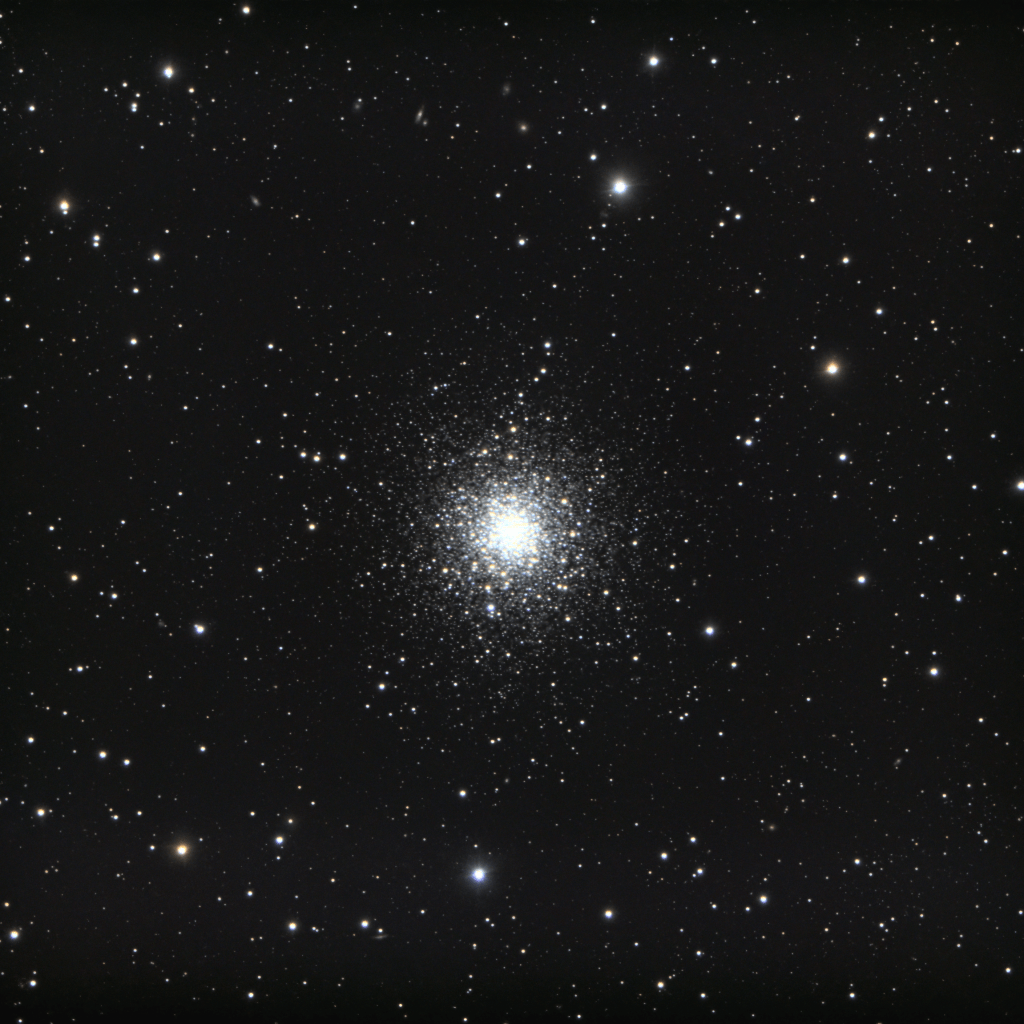
Globular clusters occupy a significant place in our understanding of the structure of our own Milkyway Galaxy. Messier 79 is one such example of a globular cluster. It is located in the constellation Lupus, the Hare, just south of Orion.
It was discovered in the early 20th Century that globular clusters contained a special type of variable stars called Cephids. Cephid variables are a unique type of variable star whose period of variability correlates to the stars’ intrinsic or absolute brightness. By comparing the difference between a star’s absolute and apparent brightness, we can calculate the distance to the star. This enabled the astronomers to calculate the distance to the globular clusters.
Our galaxy has some hundred and fifty or so globular clusters. Using the distances from the Cephid variables, astronomers were able to develop a map of their locations. The map illustrated that the globulars were not evenly distributed throughout the Milkyway. Instead, they were concentrated all around a point in the constellation Sagittarius. This revealed that the center of mass of our galaxy was in Sagittarius.
Through observation of the Magellanic Clouds and other nearby galaxies, astronomers determined that most galaxies have these globular clusters. The origin of these globulars is not well understood. Spectral analysis of their stars shows a lack of metals which indicates that the stars themselves are very old and formed in the early universe.
One interesting observation of M79 is the trail of stars coming off the top of the cluster. This is an indication that the cluster has undergone a gravitational tidal disturbance at some point in the recent past. Astronomers believe that M79 is not native to the Milkyway. It is actually part of another recently discovered galaxy, the Canis Major Dwarf galaxy. This galaxy is mostly obscured by the stars and dust within the Milkyway’s plane and difficult to observe or image. It is currently the closest known galaxy to our own. It is possible that the interaction of this galaxy with the Milkyway is causing the tidal effects on M79.
The image above was capture through my Celestron 8″SCT scope and by my ZWO ASI533MC Pro camera. It is 2 hours of 3-minute sub exposures.
 Astro-Shed
Leave a comment