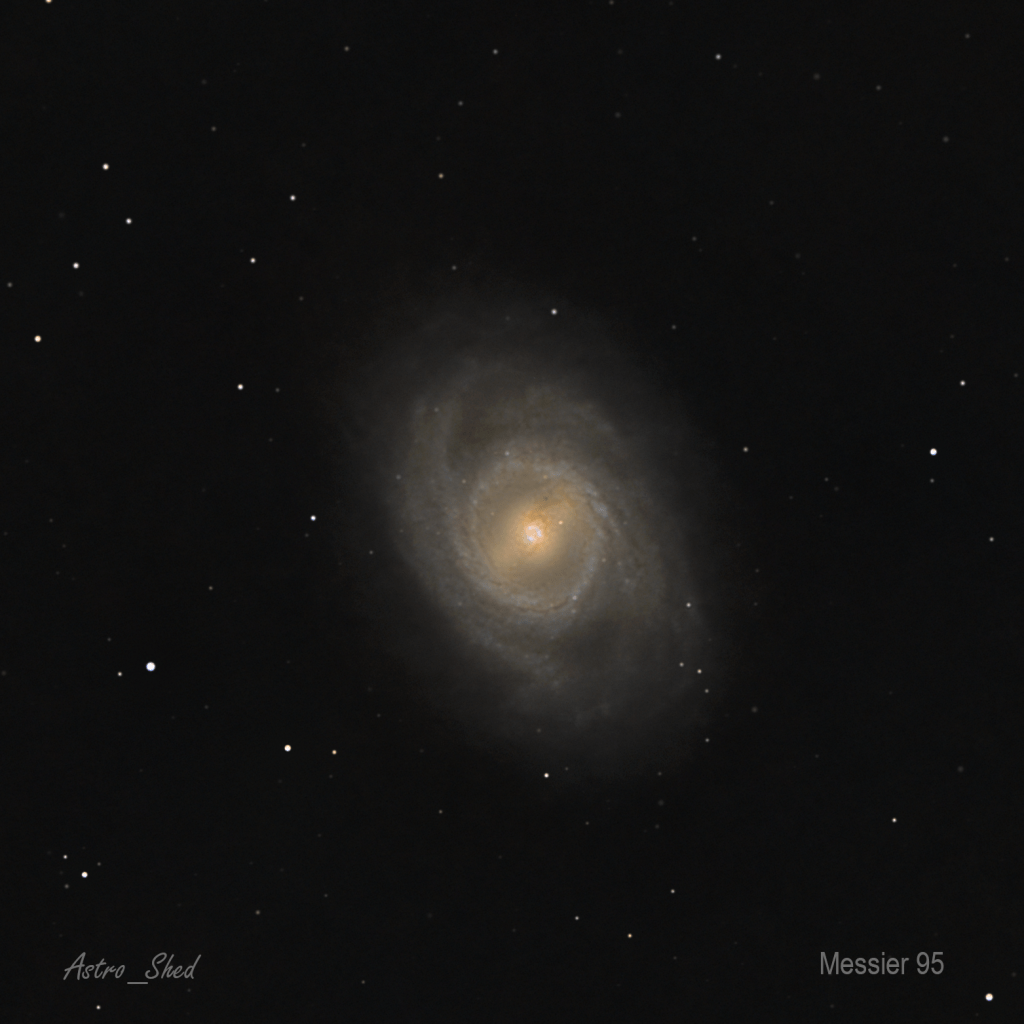
Messier 95 was discovered by Pierre Mechain in 1781, marking it as one of the noteworthy entries in the Messier catalog. It is a 9.7 magnitude galaxy located in the constellation Leo, a region of the sky known for its rich collection of astronomical objects. This stunning spiral galaxy lays about 33 million light-years from our own island galaxy, the Milky Way. Its nearness to us allows astronomers to study its structure and behavior in the context of galaxy evolution.
Messier 95 appears to us as nearly face on, displaying beautiful spiral arms and a central bar across the nucleus. The spiral arms form a ring-like structure, enclosing the bar. The galaxy is classified as a type SB(r)b. S-for the spiral. B for the bar. (r) for the ring and b for the intermediate tightness of the spiral arms.
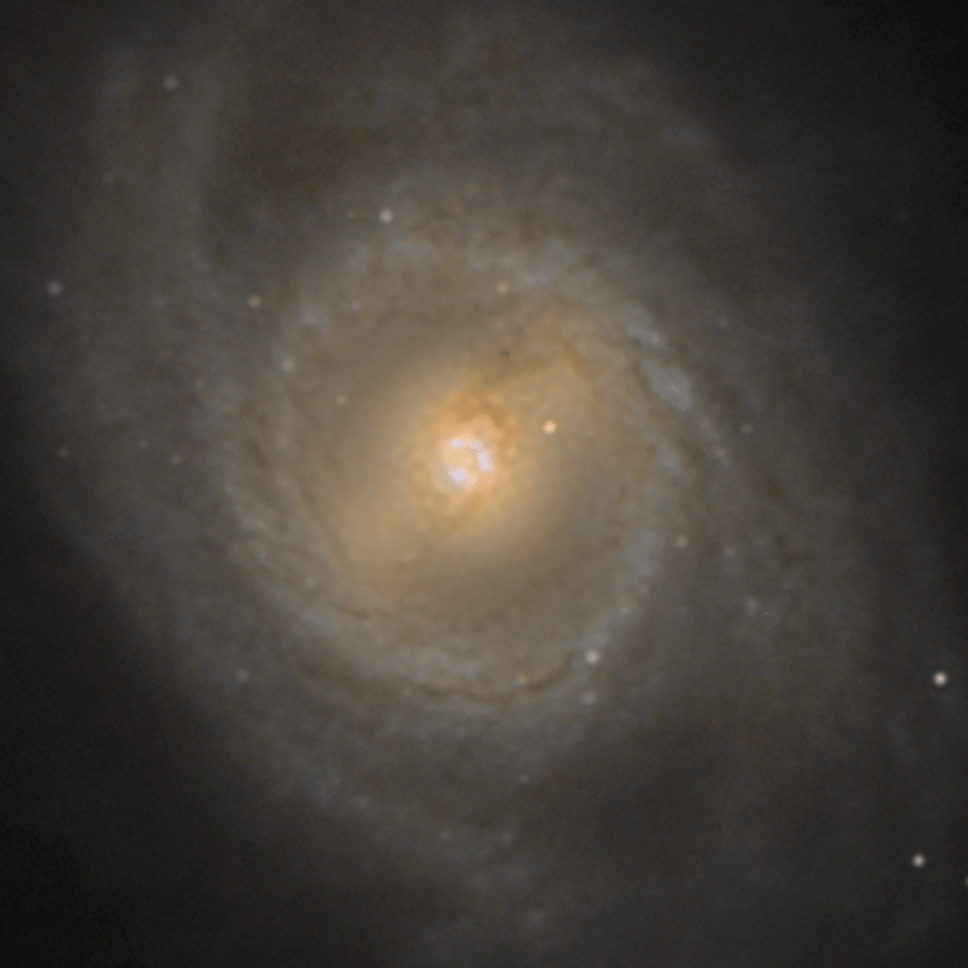
If you look closely you will notice a bright horse-shoe shaped region surrounding the galaxy’s core region. This is a star forming region of about 2,000 light years in diameter. It is made up of many clumps of clusters containing young, hot stars. This is not unlike our own star forming region that lies in Sagittarius, towards our galaxy’s core.
This image was taken on Mar-23rd with my Celestron 8″ SCT and 0.63x focal reducer. The scope was mounted on a ZWO AM5n and controlled by PHD2 guiding software. The capture was made with a ZWO ASI533 MC Pro color camera. A UV/IR filter was used to prevent over-saturating the stars as the 533 color camera is very sensitive to UV and IR light. The image is 65 subframes of 3 minutes each making a 3-hour total integration time. The processing was done in Siril, Graxpert, Cosmic Clarity and Photoshop. If I have an opportunity to image this again, I would try to integrate some narrow band exposures. This would help capture some of the Hydrogen Alpha areas.
If you have had an opportunity to image M95, paste a copy of your results in the comments. If you have not had an opportunity, I urge you to try as it is an easy object to image and can be done with an un-cooled camera or DSLR on a tracking simple mount.
 Astro-Shed
Leave a comment