I recently completed the Astronomical League’s Local and Neighboring Galaxies Imaging list. That completed project log can be found here. It was now time to take on a new project. I wanted an observing list that I could work on across multiple seasons and with multiple scope setups. An added bonus would be some variety in the list. The list I settled on was the “Two in the View” list. You can see the requirements and list of objects on the AL’s website here.
The concept behind this list is a series of objects where you would be able to capture at least two objects within the same field of view. Some of these objects might be similar types like this week’s capture, or they might be two very different objects. Either way, you would have two in the view to capture and be able to explore them in relation to each other as well as individually. So lets get started.
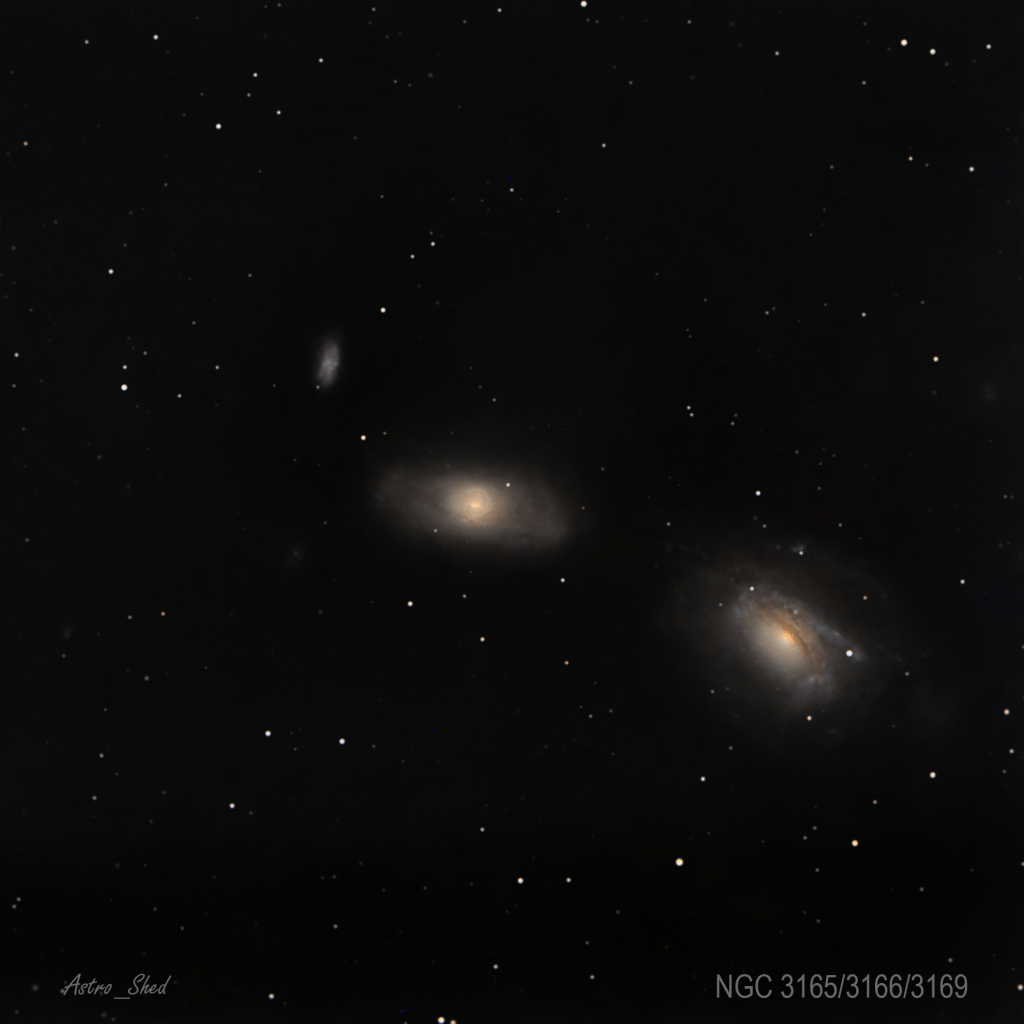
This week’s capture is actually a trio of galaxies in the Sextans constellation. The sit between Sextans and Leo under Leo’s front paw.
The field of view of the image is about 24 arc minutes. The central galaxy is furthest from us at about 58 million light years. The two on either side are each about 72 million light years away from us.
NGC 3165 is the small faint galaxy at the upper left of the group. It is an SA(s)dm? galaxy at an apparent magnitude of 14.5. The classification of SA(s)dm? suggests it is a spiral galaxy. It has tight arms forming a possible ‘S’ shape. However, due to its tilt, there is some uncertainty on the classification. The size and faintness of this galaxy makes it difficult to see any detail in this image.
NGC 3166 is the central galaxy of the image. It is a magnitude 11.3 galaxy designated as an SAB(rs). It is a weakly barred spiral with the arms forming a ring like structure. The bar is very difficult to see in the image. The ring structure does show up somewhat. This galaxy is about 14 million light years further from us than the other two. It may not be part of the group. It might just lie on the same sight line as the other two.
NGC 3169 is the most visually interesting of this trio. It is magnitude 11.5 and is classified as SA(s)a pec. It is an S-shaped spiral of an overall peculiar shape. It is more edge-on than the others in the group. This orientation allows us to see a beautiful dust lane within its disk structure. The image suggests some distortion of its arms which corresponds to its “peculiar” designation. It is approximately the same distance from us as NGC 3165. This smaller galaxy may be causing the distortion of NGC 3169 as it is closer to NGC 3169 than NGC 3166 is.
This image was captured through the Celestrom 8″SCT with a ZWO ASI533MC Pro color camera. It is 1 hour of 3 min exposures taken through a UV/IR filter.
I really enjoy seeing multiple objects in the field of view and thinking about them in relation to one another and so I look forward to moving through this list.
Clear skies.
 Astro-Shed
Leave a comment