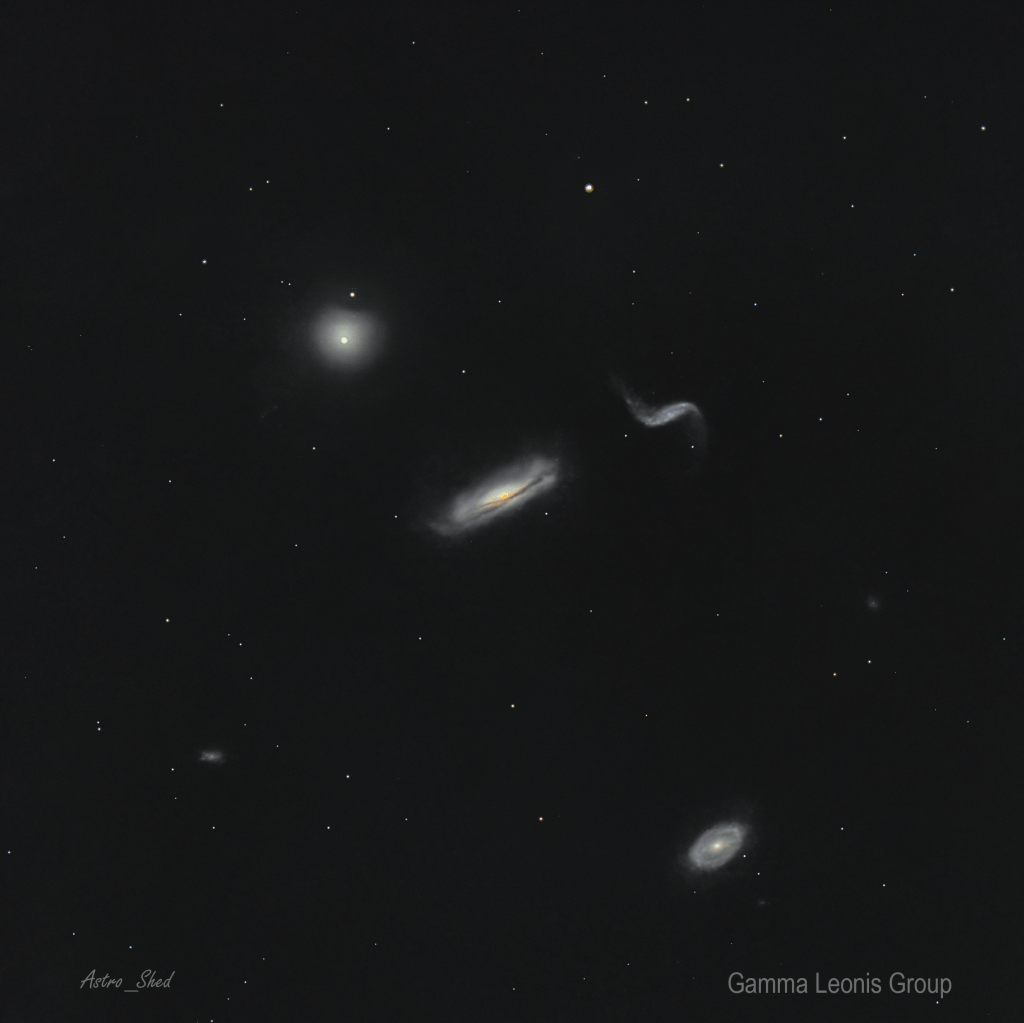
This week’s capture centers on a group of galaxies in Leo. It is called the Gamma Leonis Group. This collection is also known as Hickson 44. It lays a little more than 2 degrees away from Gamma Leo, Algieba. The group consist of 4 prominent galaxies, all centered on NGC 3190, an edge-on spiral. Halton Arp included this galaxy and its neighbors in his List of Peculiar Galaxies as Arp 316.
The central largest in the group, NGC 3190’s, Hubble classification is SA(s)a pec. It was discovered by the famous English astronomer, William Herschel in 1784. One of its striking characteristics is the dust lane bisecting its disk. It is a magnitude 11.3 object which makes it visible to modest sized scopes in darker locations. I have visually observed this galaxy in a 10″ Newtonian reflector.
Just to the right of NGC 3190 is NGC 3187. It was discovered in 1850 by an Irish physicist, George Stoney. It is much fainter than the previous one coming in at 13.8 magnitude. Similarly, it is edge-on, however, its disk shows a high degree of distortion making a graceful integral sign shape. Looking closely, there is a visible dust lane through the central part of the disk. Its Hubble classification is SB(s)c. The ‘s’ in its designation signifies an “S” shape structure. I couldn’t visually observe this galaxy through the 10″ scope when I was observing its neighbors.
In the lower right of the image lies the barred-spiral galaxy, NGC 3185. It is classified as an SB(r)a. The ‘r’ refers to a ring structure. This is made by its spiral arms and is clearly visible in the image. The bar is also visible along with the ring structure. This is a magnitude 12.9 galaxy which I observed visually with a 10″ reflector.
Lastly is NGC 3193, sitting at the upper left in the image. It is a magnitude 11.8 E2 elliptical galaxy. Elliptical galaxies are relatively boring visually as there is seldom any detail to be seen. This one is no exception. Still, the entire group is interesting because of the variety of galaxies visible in the same field of view.
The image was taken on April 27th, 2025 from my back-yard observatory through my Celestron C8 scope with a 0.63x reducer. The camera used to capture the image was a ZWO ASI533 MC Pro. The image is an integration of 20, 3 minute frames.
If you have observed or imaged this group, share your impressions in the comments.
Clear skies
 Astro-Shed
Leave a comment