
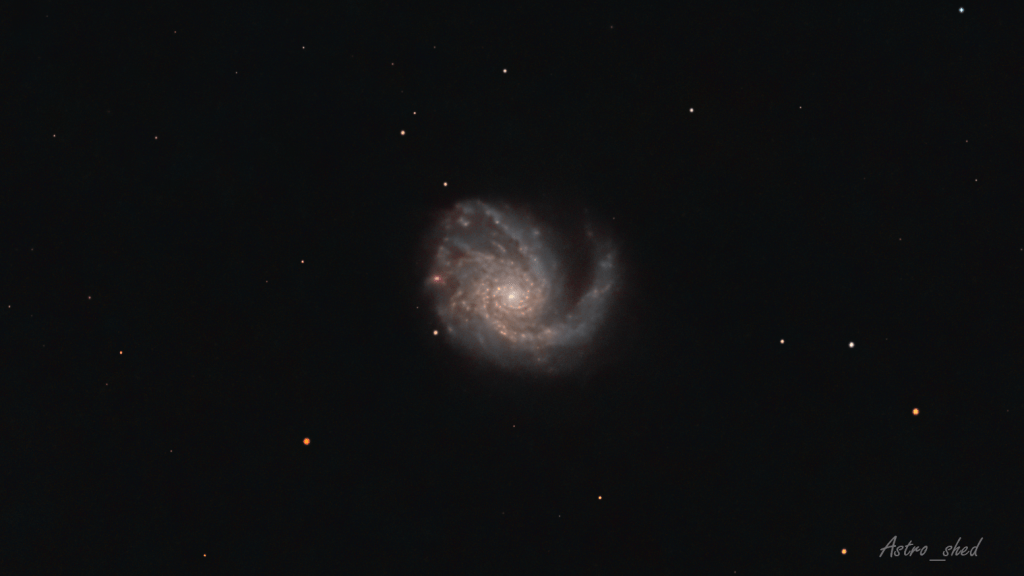
Celestron SCT 8″ with 0.63x reducer
Celestron AVX Mount
Svboney 50mm guide-scope
ZWO ASI 533 MC Pro Camera
240×30 sec subs, 2 hour integration
Celestron SCT 8″ with 0.63x reducer
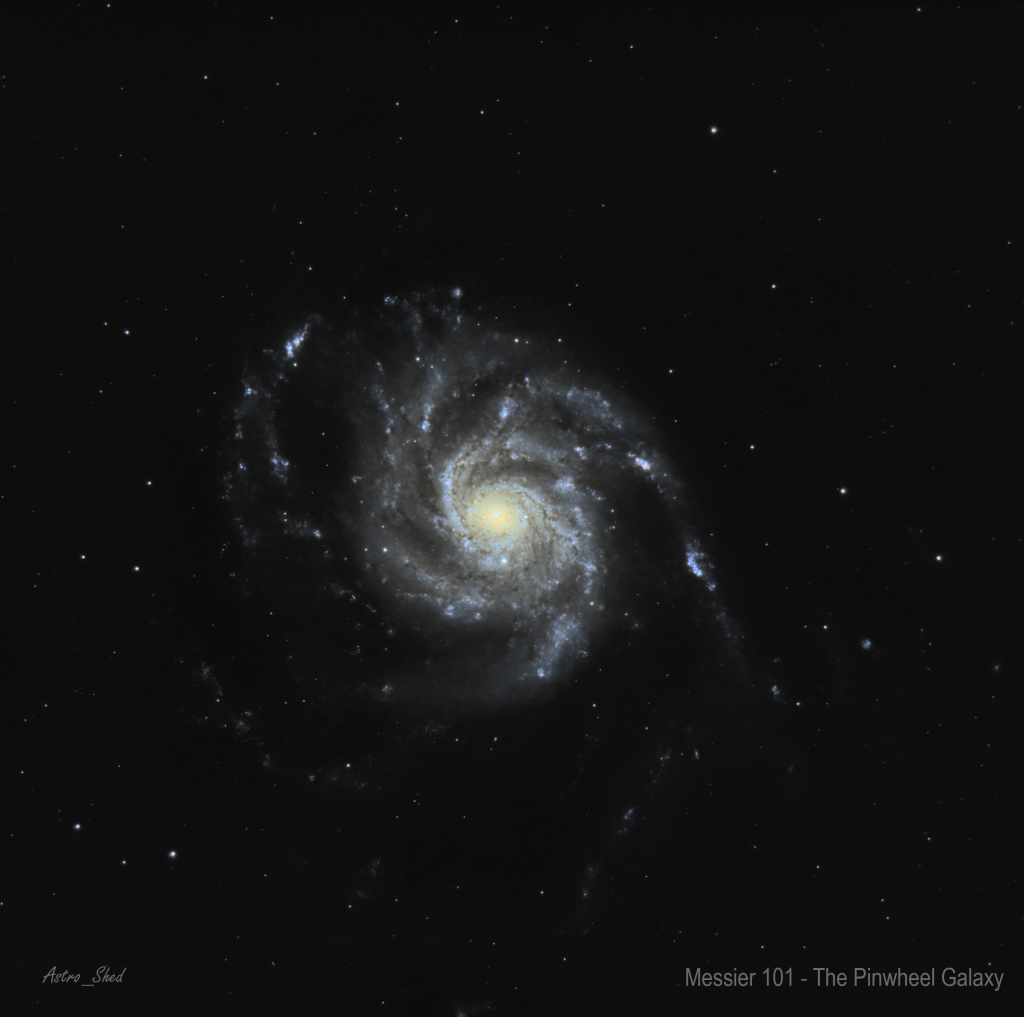
ZWO AM5n Mount
ZWO Off-axis guider
ZWO ASI 533 MC Pro Camera
40×180 sec subs, 2 hour integration
I started my serious efforts in photographing the heavens when I acquired my first equatorial mount, the Celestron AVX and my first cooled astronomic camera, the ZWO ASI 533MC Pro. Since then, I’ve learned a lot about my equipment, my imaging, and my post processing. This week’s blog explores some of those learning’s. To illustrate them, I am using two images taken by the same scope and camera. The images feature Messier 101 – The Pinwheel Galaxy. Both images have the same total integration time.
There are some very obvious differences in the images. The first thing that I see is the improvement in the sharpness of my latest attempt. There are numerous reasons for this. Image sharpness depends on 1) good guiding, 2) image scale, and 3) sharpening in post processing. However, in my opinion, quality guiding is the most important of these factors. I realized that the Celestron mount with a guide scope was inadequate for the SCT scope. It couldn’t provide the guiding accuracy that I needed. To resolve this, I purchased the ZWO AM5n mount and off axis guider. This decreased the total error in my guiding down to less than 1 arc sec RMS on most nights and 0.5 RMA on really clear nights. The mount itself proved more accurate following guiding commands than the AVX and had less periodic error. The off-axis guider improved the accuracy as well. The guiding camera and the imaging camera were now both on the same imaging axis. This setup eliminated errors from mirror flop of the SCT or flexural movements in a guide-scope.
Image scale also plays a part in the quest for sharpness. Even though the images were both taken with the same camera and scope, they are at different image scales. I took the 2024 image with the camera binned at 2×2. This was done to try and compensate for the errors in guiding that I was getting. The net result was a quarter of the pixels to display the same image. This reduces the detail that is visible in the image.
Post processing also plays its part in sharpness, although it can only do so much to repair the softness of the image caused by poor guiding and binning. The 2025 image was processed using Seti Astro’s Cosmic Clarity sharpening tool.
The other difference in the two images is the color. The 2024 image is a washed out beige color. The 2025 image displays reds, blues, and yellows. This is a result of binning the 2024 image. Binning a color camera will result in washed out, monochromatic images. There may be ways to correct this in post processing but I am unaware of them.
The 2024 image does reveal some of the fainter parts of the galaxy. The total integration time was the same for both images. Why does this happen? My thoughts are that the binning process improves the signal to noise ratio. It combines the photons from 4 pixels into 1 “super” pixel. This results in a brighter image for the same integration time. One way to prove this theory would be to increase the integration time to 4 hours, or twice that of the 2024 image. I suspect the difference in the visibility of the fainter structure will be greatly reduced.
It is inevitable that as you take more images you will become a critic of your efforts. You will start to question why one image is better than another. To help me improve my images, I keep a simple log of the details of my images. This is a simple spreadsheet which details the equipment, date, conditions, and imaging data for each object. After a while, you will start to see some trends. The data will help you understand how to improve your craft.
So where is my next major improvement in imaging going to come from, well that depends. I do have a new monochrome camera and filters on backorder. Once these arrive and are deployed in the observatory, a whole new learning curve will present itself….
I’ve also not given up on the AVX mount. There are some good on-line resources on how this mount can be improved. Perhaps that will be a subject of a future post…
Clear skies….
 Astro-Shed
Leave a comment