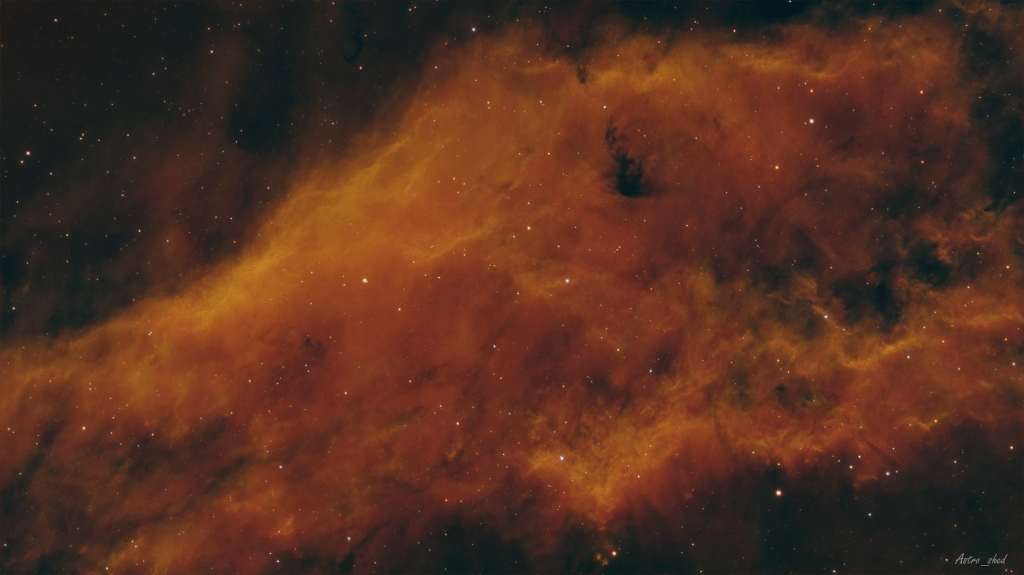
NGC 1499, commonly known as the California Nebula, is a large emission nebula in the constellation Perseus. Stretching roughly 2.5 degrees across the sky, its elongated shape resembles the outline of the U.S. state of California. The nebula lies about 1,000 light-years away and is composed primarily of glowing hydrogen gas energized by the nearby hot O-type star Xi Persei.
Discovery and Significance
NGC 1499 was discovered by Edward Emerson Barnard in 1884.Barnard discovered the nebula photographically, which was significant at the time because NGC 1499 is extremely faint visually. Its large size and low surface brightness make it difficult to detect through the eyepiece, even with large telescopes, but it shows up clearly on long-exposure photographs—especially in hydrogen-alpha light. This discovery helped demonstrate the power of astrophotography in revealing diffuse nebulae that visual observers often missed.
Image Details
The image here is only a portion of the entire nebula. It is presented in an HSO pallet which prevents the image from being overwhelmed in the green channel. The Sii signal is weaker than the Ha and thus only gives a hint of green in this pallet selection. The Oiii signal is very weak in this section of the nebula.
The image was obtained with an SV550 80mm scope and QHYCCD miniCam8. There was approximately 14 hrs of 3-minute narrow band subs and 1 hour of RGB 1-minute subs for the stars. The Ha channel was blended with the RGB luminance channel to create a master luminance that was blended in to the image to increase the contrast in the darker parts of the image.
Overall I liked how this image turned out. The 14 hours of integration time really boosted the signal to noise ratio and made the processing easier. The unusual pallet choice enhances the overall contrast and interest within the nebula.
 Astro-Shed
Leave a comment