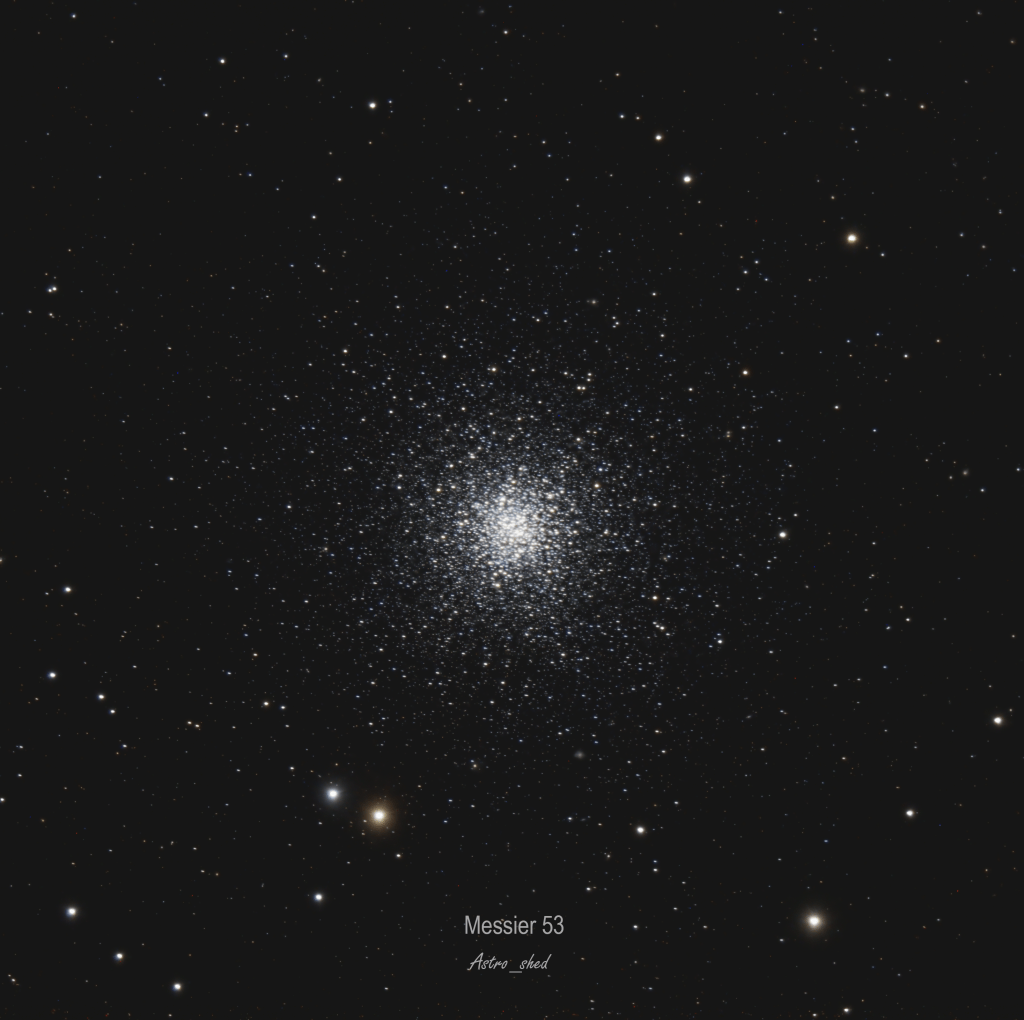
The progression from Spring to Summer comes with it the appearance of many globular clusters in the night sky like Messier 53. It was discovered by Johann Elert Bode in 1775 and catalogued by Charles Messier in 1777.
Globular clusters are ancient, among the oldest structures in the universe. Most are estimated to have formed within the first 1–2 billion years after the Big Bang, making them valuable “fossils” for studying early star formation.
- Low Metallicity: Their stars have very low metal content indicating they formed before supernovae and stellar winds had significantly enriched the interstellar medium with elements heavier than Helium.
The key to globular cluster formation lies in the conditions of star formation in the early universe:
- High gas densities and low temperatures allowed massive clumps of gas to fragment and form large numbers of stars almost simultaneously.
- These stars formed in a single burst, or sometimes in a few closely spaced bursts, giving globular clusters their characteristic uniformity in stellar age.
Globular clusters are now found in the halos of galaxies, including our Milky Way, but their formation is tied to the hierarchical assembly of galaxies:
- In situ formation: Some globular clusters may have formed within the host galaxy as it was assembling.
- Accretion: Others may have originated in dwarf galaxies that were later accreted and disrupted by larger galaxies, leaving their globular clusters behind as relics.
There is still much unknown about globular clusters and the are a subject of research to understand the early universe and galaxy formation. I find them a fascinating imaging subject and easy to process.
The image above was captured with a Celestron 8″ SCT with a 0.63x reducer, and a ZWO ASI 533MC Pro Camera. 25 – 3 minute subs were stacked and processed in Siril.
 Astro-Shed
Leave a comment