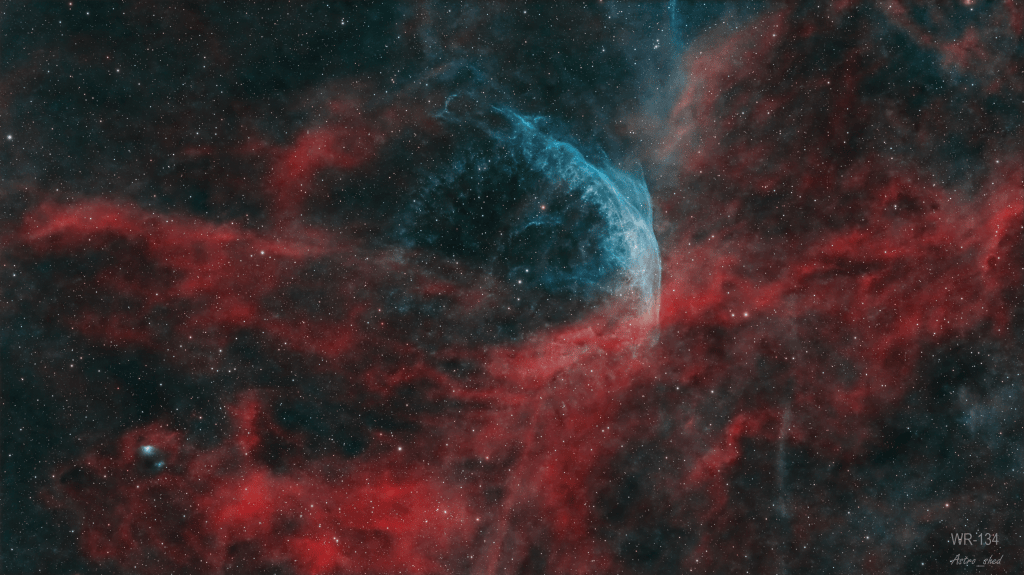
In July 2025, I began a project to image several different nebulae within the constellation Cygnus. One of those targets was WR-134.
Processing the first night’s data revealed a blue arc emerging from a sea of red emission nebulosity. At first, the arc itself was the obvious feature, but as I looked more closely at the image, I began to suspect there was more to it than the initial data had revealed.
So I planned a second night of imaging, this time concentrating more heavily on OIII—the wavelength responsible for the blue structure in the image.
The additional data paid off. The arc became a bubble, revealing the much larger structure surrounding WR-134 that you see in the image above.
What is WR-134?
The story behind that bubble begins with the star responsible for creating it.
WR-134 is a Wolf-Rayet star located about 6,000 light-years away in the constellation Cygnus. Wolf-Rayet stars are massive, highly evolved stars that have already shed much of their outer layers. They are extremely hot and drive powerful stellar winds that can reach thousands of kilometers per second.
WR-134 is also historically significant. In 1867, French astronomers Charles Wolf and Georges Rayet were studying stars in Cygnus with a spectroscope when they encountered three stars with very unusual spectra. Instead of the absorption lines normally seen in stellar spectra, these stars displayed prominent broad emission lines. Those three stars—now known as WR-134, WR-135 and WR-137—became the first known examples of the class of stars that today bears the names of their discoverers: Wolf-Rayet stars.
More than 150 years later, we know that these unusual spectra are produced by the tremendous amounts of material being expelled from these stars.
And that brings us back to the bubble in my image.
A Bubble Carved by a Star
WR-134 is losing material through an extraordinarily powerful stellar wind. As that fast-moving material encounters gas previously expelled by the star—and the surrounding interstellar medium—it compresses, heats and excites the gas.
Over time, the stellar wind effectively excavates a cavity around the star and piles material into shells and filaments along its boundaries.
The most prominent evidence of that process in my image is the blue-green bubble surrounding WR-134. What initially appeared in the first night’s data as a bright arc turned out to be only the most obvious portion of a much larger structure.
Looking carefully at the finished image also reveals additional, smaller structures closer to WR-134. It is tempting to interpret each of these as separate episodes in the star’s history, but the environment around a Wolf-Rayet star is complex. Winds from different stages of the star’s evolution interact with previously expelled material and with the surrounding interstellar gas. What we are seeing is the accumulated result of that interaction.
What the Colors Tell Us
The colors in this image aren’t simply an artistic choice. They represent light emitted by different ionized gases.
The red emission is primarily hydrogen-alpha (Hα). Hydrogen is abundant throughout this region of Cygnus, and when ultraviolet radiation ionizes the hydrogen gas, it produces the characteristic deep-red Hα emission seen throughout the background of the image.
The blue and cyan structures come from doubly ionized oxygen, or OIII. Producing strong OIII emission requires considerably more energetic conditions than Hα. Around WR-134, it is particularly useful for revealing the highly excited gas associated with the interaction between the star’s powerful wind and its surroundings.
That difference is why the two gases tell such different stories.
Hydrogen fills much of the field, producing the broad red background of emission nebulosity. OIII is much more concentrated in the shell surrounding WR-134.
Separating the image into its individual Hα and OIII components makes that distinction even more obvious. The hydrogen shows the larger environment in which WR-134 resides, while the oxygen traces the remarkable bubble carved within it.
In a sense, the colors allow us to see two different aspects of the same physical environment.
Capturing WR-134
My original imaging plan was relatively straightforward: collect Hα and OIII data along with RGB data for natural-color stars.
That plan changed after I processed the first night’s images.
The OIII arc was clearly present, but there were hints of much fainter oxygen emission extending beyond it. Rather than simply collecting equal amounts of additional Hα and OIII, I decided to devote considerably more of the second night to OIII.
The final dataset totaled approximately 14 hours, with the narrowband data weighted about 1:2 in favor of OIII over Hα.
That additional OIII integration made the difference. The faint structure surrounding the bright arc became strong enough to process confidently, and the arc became a bubble.
This is one of the things I enjoy most about astrophotography. An imaging plan doesn’t always survive first contact with the data. Sometimes the first night’s images tell you where to look next.
Processing the Image
The Hα and OIII channels were processed separately before being combined into the final HOO image.
My main processing objective was not simply to make the oxygen shell brighter. I wanted to reveal its faint outer structure while preserving the much broader hydrogen emission surrounding it. Pushing the OIII too aggressively would make the bubble spectacular, but it could also disconnect it visually from the environment in which it exists.
The stars were processed separately using RGB data and then returned to the narrowband image. This allowed the nebula to be displayed using the Hα and OIII emission while retaining more natural stellar colors.
Sharpening and noise reduction were applied conservatively, particularly in the faint OIII regions. Those areas contain the very structures that motivated the second night of imaging, so preserving them without creating artificial detail was an important part of the final processing.
The Reward of Looking Deeper
WR-134 is already approaching the final stages in the life of a massive star. Its powerful winds are stripping material from the star and returning it to the surrounding interstellar medium. Eventually, a star of this type is expected to end its life in a supernova, returning still more material to space—material that may someday become part of another generation of stars and planets.
That makes the bubble surrounding WR-134 more than an interesting photographic target. It is a visible record of a massive star actively changing its environment.
For me, though, there is also a much simpler lesson in this image.
After the first night, I could easily have considered the project successful. The OIII arc was clearly visible and the image already contained plenty of structure.
But there was just enough faint signal beyond that arc to make me wonder what else might be there.
So I went back for another night.
The arc became a bubble.
And that is often the reward in astrophotography for looking a little longer and going a little deeper.


Leave a Reply