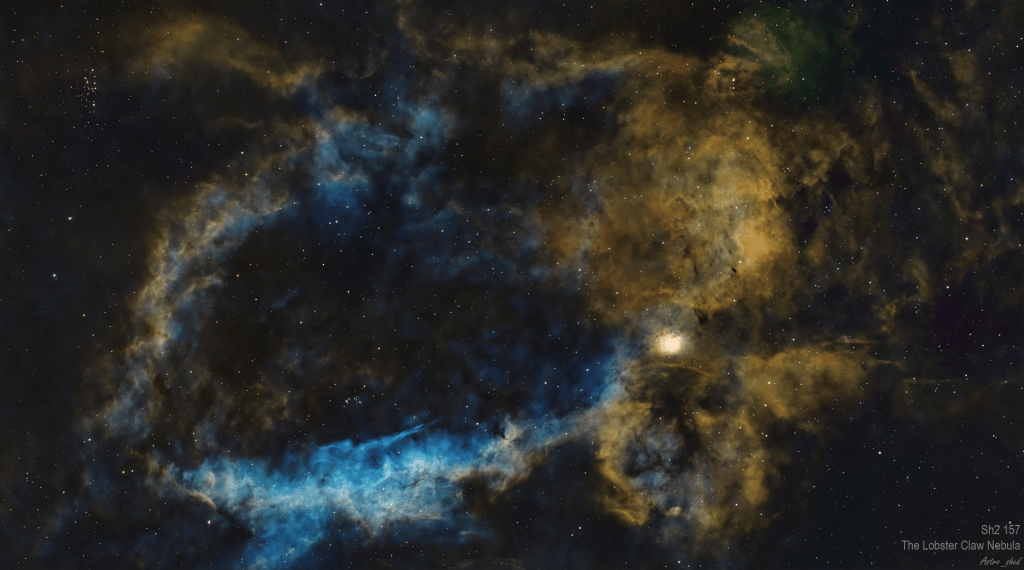
Sh2-157, better known as the Lobster Claw Nebula, is one of those targets that becomes more interesting the longer you look at it.
At first glance, the most obvious feature is the bright, sweeping arc of nebulosity that gives the object its nickname. But after spending two nights imaging the region and then digging into SIMBAD and the published literature, I found that the field contains several distinct stories: a Wolf–Rayet star, a young open cluster, a compact H II region, another nearby cluster, and evidence that several generations of star formation may be linked.
That made Sh2-157 a perfect target for the kind of image I enjoy making — one where the finished photograph becomes the starting point for exploring what is actually happening in the field.
Acquisition
I imaged Sh2-157 with my SVBONY SV550 80mm refractor, paired with the QHYCCD MiniCam8 mono camera and mounted on the ZWO AM5R.
The target was captured in the classic SHO narrowband palette, using SII, Ha and OIII filters.
For both nights I used:
- 300-second narrowband exposures
- 3:3:3 SII:Ha:OIII cadence
- dither after every three frames
- RA and Dec dithering
- approximately 16 hours total narrowband integration
I also captured 5-second RGB exposures specifically for the stars.
The first night produced about eight hours of usable SHO data and already showed the major structures clearly. The lower claw was bright and well defined, and the broad outer arcs were visible.
But the central region between the claw structures was still relatively weak, and the large area of nebulosity on the right side lacked the depth I wanted.
Rather than changing the filter ratio, I decided to repeat the same balanced 3:3:3 cadence for a second night.
That turned out to be the right decision.
The additional integration substantially improved the faint emission in the central region and gave the right side of the field much more structure. More importantly, it allowed those areas to be brought forward during processing without having to push the stretch too aggressively.
What Is Sh2-157?
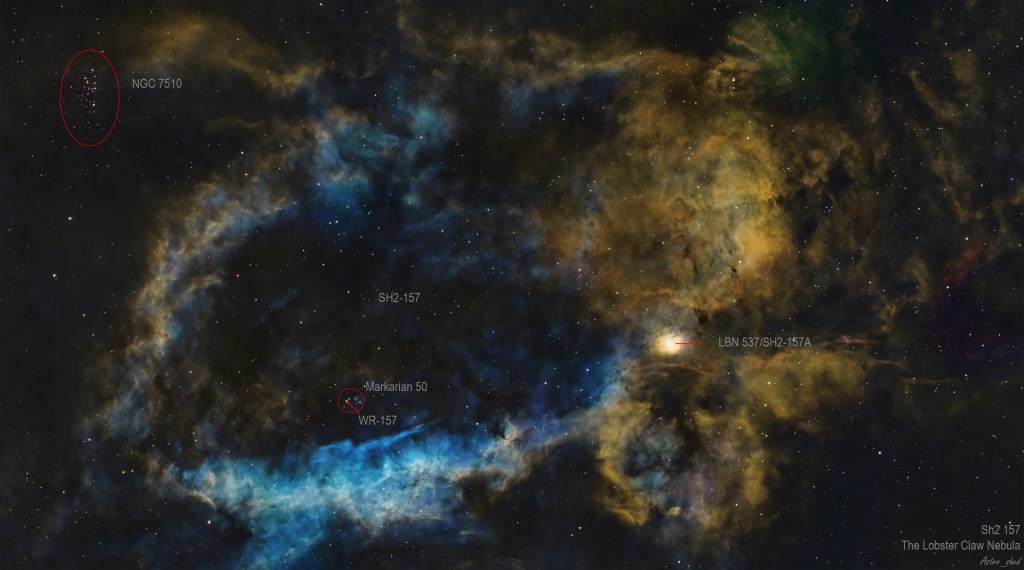
Sh2-157 is a large H II complex located in Cassiopeia, in the direction of the Perseus spiral arm.
Published studies divide the complex into two broad optical components. The northern region, known as SG 13, contains the characteristic claw-shaped structure and is associated with the young open cluster Markarian 50. A more diffuse region, SG 14, lies farther south.
The distance to Markarian 50 has been measured at approximately 3.46 ± 0.35 kpc, or roughly 11,000 light-years, placing Sh2-157 well into the Perseus Arm.
The region contains several especially interesting objects.
Markarian 50 and WR 157
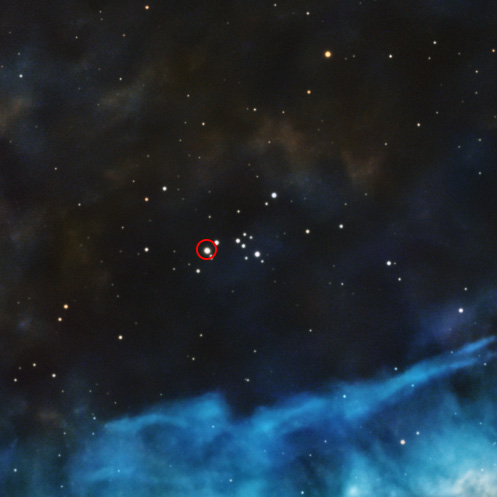
Near the lower blue arc in the image is the compact young open cluster Markarian 50.
It is easy to overlook.
Even more unassuming is one of its members: WR 157, also known as HD 219460B.
WR 157 is a WN5 Wolf–Rayet star, and that designation tells us something important. Wolf–Rayet stars are evolved descendants of massive stars that have lost much of their outer envelope and now expose extremely hot internal layers.
They are characterized by powerful stellar winds and intense ultraviolet radiation.
Markarian 50 itself has an estimated age of roughly 7.5 ± 2 million years, and research suggests that the progenitor of WR 157 had an initial mass greater than roughly 20 solar masses.
What makes WR 157 especially interesting photographically is how inconspicuous it looks.
In my image, it appears as little more than another star in a small cluster.
Yet research on the region places WR 157 near the center of a large shell-like structure roughly 27 arcminutes across. Its stellar wind, together with the earlier wind and radiation from its massive-star phase, has played an important role in excavating and energizing the surrounding gas.
That contrast is one of my favorite things about this image.
The star itself is modest.
Its influence is enormous.
Why the OIII Arcs Matter
The blue arcs visible in the SHO image are areas where OIII emission becomes particularly prominent.
OIII emission arises from doubly ionized oxygen and generally requires relatively energetic radiation or shocked gas.
In a region containing a Wolf–Rayet star, both are available.
WR stars drive fast winds into the slower material previously expelled by the star and into the surrounding interstellar medium. Those interactions can create expanding shells, compressed filaments and shock fronts.
The large claw-shaped arcs surrounding Markarian 50 are therefore not simply decorative nebular structures. They are evidence of massive-star feedback physically reshaping the surrounding cloud.
A multifrequency study of the region specifically investigated SG 13 as a ring nebula associated with WR 157 and Markarian 50.
LBN 537 / Sh2-157A
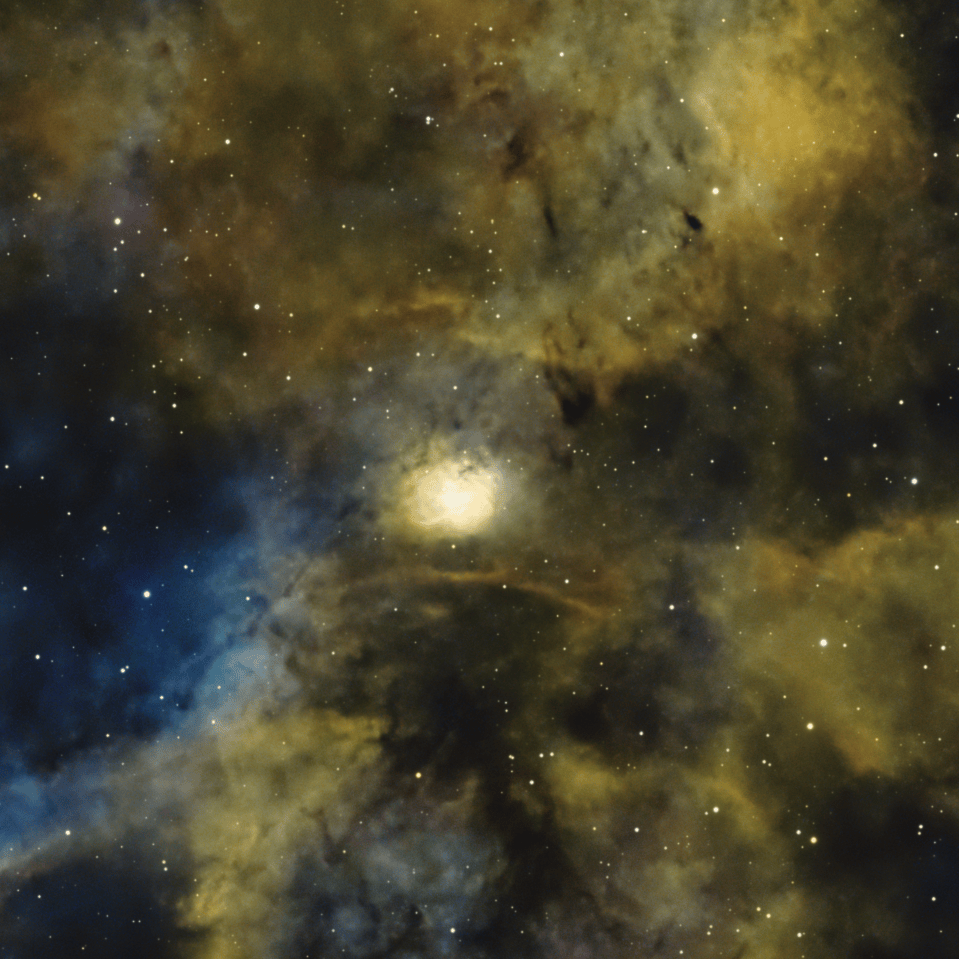
The bright compact knot toward the right side of my image is LBN 537 / Sh2-157A.
This is not merely a bright portion of the same shell.
It is a localized H II region within the wider Sh2-157 complex.
Recent multiwavelength research describes the Sh2-157A/B region as part of a massive star-forming site embedded in a giant molecular cloud. Sh2-157A includes the visible optical H II region, while Sh2-157B, located only about 50 arcseconds to the southwest, contains a deeply embedded multiple young stellar object associated with a compact H II region.
That means the small bright knot visible in the optical image is part of a much more complex star-forming environment than it first appears.
Some of the youngest massive stars in the area may still be hidden inside their natal cloud.
NGC 7510
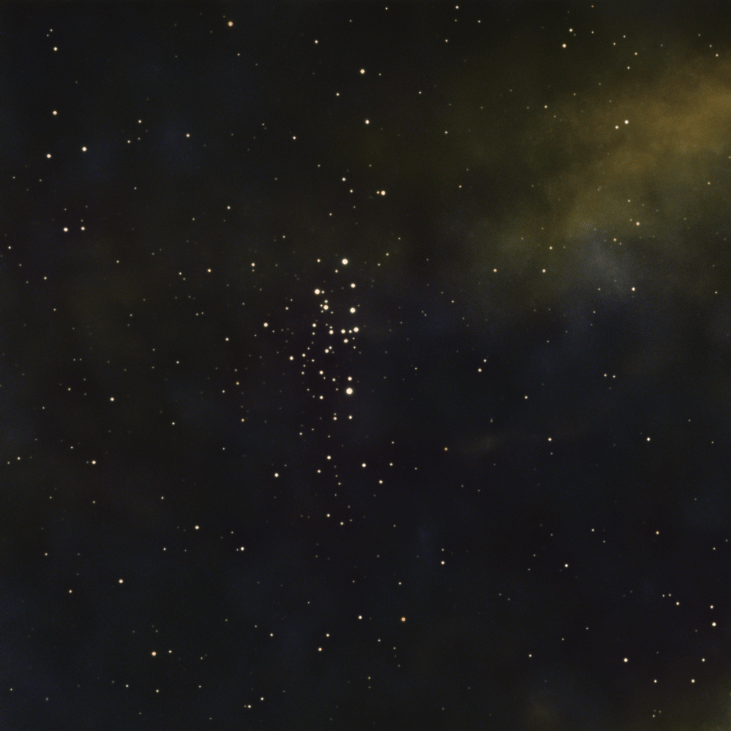
In the upper-left corner of the image is another compact open cluster, NGC 7510.
It lies at approximately 3.1–3.2 kpc and is also a young stellar population, with most studies placing its age in the range of roughly 10 million years, although published estimates vary.
Its location and age become particularly interesting when considered alongside Markarian 50 and Sh2-157A.
These objects may not simply happen to lie in the same field.
A Possible Cascade of Star Formation
One of the more intriguing ideas proposed for this region is that we may be looking at successive generations of star formation.
Earlier research suggested a possible sequence beginning with the larger Cassiopeia OB2 association, followed by NGC 7510, then Markarian 50, and finally the compact H II region Sh2-157A.
In this scenario, winds and radiation from one generation of massive stars compress nearby molecular material, helping trigger the next generation of star formation.
The similar distances derived for NGC 7510 and Markarian 50 strengthen the argument that these objects may be physically related rather than merely aligned by chance.
This does not mean every step in the sequence is proven, but it is a compelling interpretation of the structure and ages of the region.
More recent infrared and molecular-cloud studies reinforce the idea that Sh2-157 is still an active star-forming environment. The complex contains multiple compact infrared sources, young stellar objects and dense molecular material associated with ongoing massive-star formation.
A Region Shaped by Generations of Massive Stars
What started for me as an imaging target quickly became much more interesting.
Sh2-157 contains several different stages of stellar evolution in one field.
There are young open clusters.
There are massive stars that are still forming.
There is a compact H II region powered by recently formed stars.
And there is WR 157 — a massive star approaching the final stages of its evolution, still reshaping the environment around it through radiation and powerful stellar winds.
That is what makes this image particularly interesting to me.
The Lobster Claw is not simply a cloud glowing in space.
It is a record of multiple generations of massive stars forming, evolving and altering the environment around them.
And perhaps the best example of that story is one of the least impressive-looking stars in the entire image.
WR 157 may be easy to overlook.
The nebula it helped create certainly is not.
Clear skies


Leave a Reply